In the stark shadow of 9/11, many otherwise patriotic Americans seem to have forgotten that the U.S. Constitution unequivocally guarantees our right and freedom to practice whatever religion we desire. From the high-profile protests against the “Ground Zero Mosque”* to the knifing of a Muslim cabbie in New York City and the Florida pastor who coordinated (and then cancelled) a Koran bonfire at his church, it's become all too painfully clear that America is afflicted with an advanced case of Islamophobia. Obviously, some of our fellow citizens are mistakenly equating the vast majority of peaceful mainstream Muslims with the comparatively small number of enraged jihadists who indiscriminately kill in Allah's name—turning all Muslims into potential targets of hate crime.
Islam and animal rights share at least one unfortunate commonality: the more extreme elements in both camps top the FBI's list of the most dangerous domestic terrorism threats facing our nation. Of course, the feds specifically bestow this dubious distinction on those who use violent and/or destructive means to achieve their ends, but in some people's minds, anyone who follows the philosophy of either Islam or animal rights is guilty by association of conspiring with the enemy—even if we would (literally) never hurt a fly. In that way, veg Muslims may be doubly suspect in a society that's still reeling from the traumatic impact of a shocking mass-murder nine years after the fact.
As an American and a human being, it sickens me to see anyone persecuted for their spiritual beliefs—as much as seeing animals tortured in factory farms and other industrialized death camps. I therefore feel compelled to stand up for peaceful Muslims, but as a secular agnostic, I would not presume to speak for them. It is in this spirit of solidarity that I present my exclusive interview with blogger, financial analyst and vegetarian American Muslim Fareeda Ahmed.
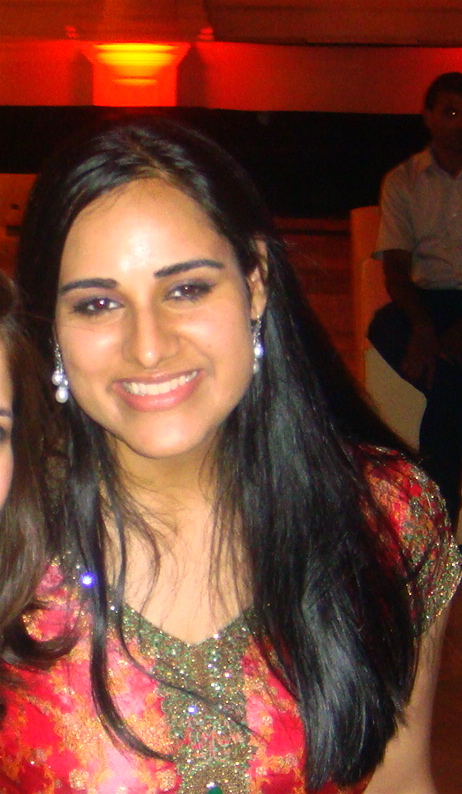 AR: Where are you from, and where did you grow up?
FA: I'm from New York. I was born in Manhattan and raised mostly in Westchester County, but I also lived in New York City for a number of years because I got my undergraduate degree at Columbia, and then worked at Morgan Stanley. My parents, on the other hand, were both born and raised in Pakistan, and came to the U.S. and got married after my father did his medical residency here. A lot of our family still lives in Pakistan, so I usually make a trip there every year. And I just moved to California last month to get my MBA at Stanford.
9/11 was obviously a pivotal point in American history and our relations with Muslims. Were you by any chance in New York City on September 11th, 2001?
No, at that time I was just 16—going on 17, as the song** goes—and a high school senior in Tarrytown, which is on the Hudson River about a half hour's train ride from the city. The entire school of about 400 students just so happened to be at an assembly that morning, and about 45 minutes into it, the headmaster interrupted to announce that two planes had been deliberately crashed into the Twin Towers. Our proximity to the World Trade Center meant that many of my classmates' parents and family members worked in or around there—my own cousin worked at the time for Morgan Stanley, sometimes in their WTC office—so the shock of that day was particularly personal for us.
How did you feel when you learned that the hijackers were Muslim?
I felt a strong dual connection to America and New York—my country and my home state. I was struck hard by the reality that they had both just been attacked so violently and viciously, while also realizing that this tragedy was going to dramatically change things for Muslims here in America and around the world. For me, and for many others I think, it marked the end of childhood. Speaking as a Muslim, it was the start of being defensive, because I've always been sort of an unwitting diplomat for Pakistan, which I consider a kind of second home. There, I don't have to explain myself for being Muslim, but here, I am constantly reminded that I follow a different religious faith from most Americans. And to complicate matters, Pakistan has a reputation as a hiding place for some of Al Qaeda's most wanted. Even though it's one of America's strongest allies in the War on Terror, and Pakistani soldiers and civilians die every day in the fight against Al Qaeda, the associations Americans have with Pakistan are often negative, unfortunately.
It seems like many Americans these days believe that Muslims, even those born and raised here, are somehow sympathetic to or supportive of the terrorists—like they're secretly celebrating when Americans are killed. Do you ever experience divided loyalties between your country and religion?
Not only do I not sympathize with people who commit acts of terror in the name of Islam, but it affects me directly because I lived in Manhattan, and worked in places like Times Square and the New York Stock Exchange that are among the top terrorist targets in the U.S. I worked at Morgan Stanley for four years, which had more office space in the WTC on 9/11 than any other company, and a lot of my co-workers had horrifying stories about surviving the attack. This past May, I took my father to see a play on the same day that a car bomb almost went off in Times Square. The theatre was only one block from where the bomb would have exploded, and the show ended just an hour before it was set to detonate, meaning my father and I could have been killed if the attack had been successfully carried out. So when I hear, for example, that Iran may be developing nuclear weapons, I don't sympathize with the Iranian government. Instead, as an American and a person who could potentially be on the receiving end of those missiles, I feel the same fear that anyone else would. But being Muslim in America, there's the added dimension of not being allowed to feel that way because we're so misunderstood.
Do you feel life has gotten more difficult for Muslim Americans in the wake of 9/11?
Faisal Shahzad, the would-be “Times Square Bomber,” really ruined the accepted profile of Muslim terrorists as being from some foreign country. He was an American citizen with a wife and kids and a good job, so now people think that any Muslim—even their friendly mild-mannered neighbors—could be part of a covert sleeper cell. Otherwise, there were ups and downs over the years since 2001, but overall, things appeared to be improving for us. Then last month everything suddenly came to a head. Right after 9/11, people seemed curious about and only slightly distrustful of Muslims, but now many people just seem to jump to conclusions without even trying to get the facts. If there is a silver lining here, though, it's that today's rage provides an opportunity for reconciliation, and I know that Americans are basically caring and open-hearted people, so they'll eventually summon their better angels. Inclusiveness and tolerance are core American and Islamic values, and Muslims come from the same religious lineage as Christians and Jews. Realizing our commonalities is ultimately what will unite us in the fight against global terrorism.
Since my blog is about animal issues, let's switch gears and address some. I understand that Islam includes a strong tradition of concern for animal welfare. Can you please speak to that?
Well, there are very specific instructions in the Koran about how Muslims are to treat animals used as resources, whether they are beasts of burden or slaughtered for food. Generally speaking, Muslims must take care to minimize the suffering of other species. An example would be Halal meat standards, which require that butchers follow sacred practices to ensure animals slaughtered for food don't suffer unnecessarily. Integral to Halal methods is that Islam expressly forbids the caging, beating, branding, and mutilation of animals***. Quotes from the Koran about animals leave very little gray area about how Muslims must universally respect other species as fellow sentient beings, and it was partly my interpretation of Islam that led me to become a vegetarian. I mean, when I really started to think about it, eating meat just seemed to conflict with my Muslim sensibilities, which include compassion for all forms of life and ecological stewardship.
Every vegetarian has a personal transformation story about why they chose not to eat animals, so what's yours?
I decided to go vegetarian about two and a half years ago after becoming aware of certain factory farming practices, and then reading up on vegetarianism in the context of Islam at a PETA website which I later wrote a blog post about. I was also informed and influenced by books such as Skinny Bitch and documentaries like Food, Inc. Meanwhile, as I learned more about factory farming, I realized how totally contrary this system is to the spirit of Islam. Bear in mind, Islam doesn't dictate that we Muslims can't eat meat—that's why Halal was invented—so I could have easily purchased Halal meat in the city. Yet I felt, as a Muslim and a human being, that vegetarianism was a more compassionate choice, and that my faith was telling me not to eat animals. There's a passage in the Koran that basically says “Whoever has done an atom's worth of good will see it, and whoever has done an atom's worth of evil will see it,” which means we are all accountable for our individual choices, including how we treat animals. And health-wise, within about three months of phasing meat out of my diet, I looked and felt noticeably better, and had lost a few pounds, so it definitely felt right physically, as well.
Since vegetarianism has had such a positive impact on your life, have you considered taking it to the next level by going vegan? I ask this question as someone who was vegetarian for six years before going vegan, and experienced exponential benefits after abstaining from all animal products.
Veganism makes complete sense to me in theory, and it's certainly the ideal I want to move towards in the future. But at the same time, I've found it so much harder to stop eating dairy than meat. I know that's not a very compelling argument for eating these foods, and that dairy cows and egg-laying chickens still suffer, even if they're not raised on factory farms. I look at both my own life and the history of Islam on a trajectory, with progress building on the foundations laid by previous actions. Consider where Islam came out of, for example. Pre-Islamic Mecca, now Saudi Arabia, during the 6th to 7th centuries was a barbaric place where baby girls were summarily killed at birth. Islam helped create a more civilized society that outlawed some of the harshest practices of that era, including unrestrained cruelty to animals. One of Islam's key philosophical tenets, in my understanding, is that we must work towards a better world step-by-step. It's a question of evolution, and vegetarianism is a more evolved diet than meat-eating. And as you follow that trajectory to its logical conclusion, for me personally, it ultimately leads towards veganism.
Do you have Muslim friends who are also veg?
A few, but not many. It's not like I've sought out other vegetarian Muslims by, say, looking for them on Facebook, though. The ones I do know don't cite Islam as their primary reason for not eating meat: they express the same concerns about ethics, environmentalism and health that other vegetarians do. Also, I have many South Asian vegetarian friends, but they're not necessarily Muslim: they're Hindu, Jain or Buddhist.
Regarding vegetarian advocacy, do you find that meat-eating Muslims are more receptive to the vegetarian message when it comes from a member of their own faith?
Yes, because when I tell them about how the vast difference between industrialized agriculture and Halal standards effectively makes factory farming a sacrilege in Islam, I'm speaking from personal experience. So, out of respect for our traditions, Muslims may be more open than other meat eaters to changing their dietary habits—at least in terms of rejecting factory farm cruelty, if not giving meat up altogether. But many people don't know that at least 98% of the meat produced in the U.S. comes from factory farms, so even when they learn that Islam strictly prohibits the consumption of flesh from tortured animals, they may continue turning a blind eye to avoid being inconvenienced.
What are some of the most popular vegan foods in Muslim culture?
There are about 1.5 billion Muslims in the world, and they're spread across the globe, so food traditions vary quite widely. But vegans can enjoy foods from many different Islamic countries. For example, my family comes from the Punjab region of Pakistan near the Indian border, which specializes in dishes made from rice, vegetables and rich curry sauces. Vegans can also find many delicious options from the Middle East, Malaysia, Indonesia, and Morocco. Personally, my favorite food is probably chhole, which is an Indian/Pakistani dish made with spiced chick peas served warm. As a vegetarian, I can confidently say that I'm definitely not missing meat at all—not even my mom's famous chicken!
* In explanation of my consciously-included quotation marks, fans of The Daily Show may recall a recent episode in which Emmy award-wining host Jon Stewart humorously observed that the “Ground Zero Mosque” would be neither a mosque (but rather a community center) nor located at Ground Zero (but rather two blocks away in a former Burlington Coat Factory outlet).
*** See The Animal Ethics Reader, p. 237.