Vote Veg! That's the message of "Meat-Free Politicians," my new article which VegNews magazine published on their website today. The piece includes short profiles of five vegetarian leaders at the national, state and local levels:
- US Congressman Dennis Kucinich
- US Congresswoman Betty Sutton
- Maryland State Senator Jamie Raskin
- California Assemblyman Jim Beall, Jr.
- San Francisco Supervisor Sophie Maxwell
My aim was to highlight the work that each of these elected officials has done to help move the veg cause forward.
In the stark shadow of 9/11, many otherwise patriotic Americans seem to have forgotten that the U.S. Constitution unequivocally guarantees our right and freedom to practice whatever religion we desire. From the high-profile protests against the “Ground Zero Mosque”* to the knifing of a Muslim cabbie in New York City and the Florida pastor who coordinated (and then cancelled) a Koran bonfire at his church, it's become all too painfully clear that America is afflicted with an advanced case of Islamophobia. Obviously, some of our fellow citizens are mistakenly equating the vast majority of peaceful mainstream Muslims with the comparatively small number of enraged jihadists who indiscriminately kill in Allah's name—turning all Muslims into potential targets of hate crime.
Islam and animal rights share at least one unfortunate commonality: the more extreme elements in both camps top the FBI's list of the most dangerous domestic terrorism threats facing our nation. Of course, the feds specifically bestow this dubious distinction on those who use violent and/or destructive means to achieve their ends, but in some people's minds, anyone who follows the philosophy of either Islam or animal rights is guilty by association of conspiring with the enemy—even if we would (literally) never hurt a fly. In that way, veg Muslims may be doubly suspect in a society that's still reeling from the traumatic impact of a shocking mass-murder nine years after the fact.
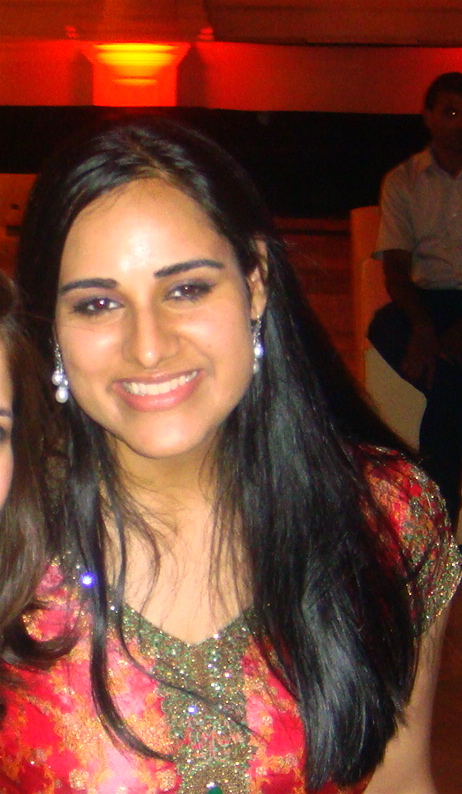
As an American and a human being, it sickens me to see anyone persecuted for their spiritual beliefs—as much as seeing animals tortured in factory farms and other industrialized death camps. I therefore feel compelled to stand up for peaceful Muslims, but as a secular agnostic, I would not presume to speak for them. It is in this spirit of solidarity that I present my exclusive interview with blogger, financial analyst and vegetarian American Muslim Fareeda Ahmed.
AR: Where are you from, and where did you grow up?
FA: I'm from New York. I was born in Manhattan and raised mostly in Westchester County, but I also lived in New York City for a number of years because I got my undergraduate degree at Columbia, and then worked at Morgan Stanley. My parents, on the other hand, were both born and raised in Pakistan, and came to the U.S. and got married after my father did his medical residency here. A lot of our family still lives in Pakistan, so I usually make a trip there every year. And I just moved to California last month to get my MBA at Stanford.
9/11 was obviously a pivotal point in American history and our relations with Muslims. Were you by any chance in New York City on September 11th, 2001?
No, at that time I was just 16—going on 17, as the song** goes—and a high school senior in Tarrytown, which is on the Hudson River about a half hour's train ride from the city. The entire school of about 400 students just so happened to be at an assembly that morning, and about 45 minutes into it, the headmaster interrupted to announce that two planes had been deliberately crashed into the Twin Towers. Our proximity to the World Trade Center meant that many of my classmates' parents and family members worked in or around there—my own cousin worked at the time for Morgan Stanley, sometimes in their WTC office—so the shock of that day was particularly personal for us.
How did you feel when you learned that the hijackers were Muslim?
I felt a strong dual connection to America and New York—my country and my home state. I was struck hard by the reality that they had both just been attacked so violently and viciously, while also realizing that this tragedy was going to dramatically change things for Muslims here in America and around the world. For me, and for many others I think, it marked the end of childhood. Speaking as a Muslim, it was the start of being defensive, because I've always been sort of an unwitting diplomat for Pakistan, which I consider a kind of second home. There, I don't have to explain myself for being Muslim, but here, I am constantly reminded that I follow a different religious faith from most Americans. And to complicate matters, Pakistan has a reputation as a hiding place for some of Al Qaeda's most wanted. Even though it's one of America's strongest allies in the War on Terror, and Pakistani soldiers and civilians die every day in the fight against Al Qaeda, the associations Americans have with Pakistan are often negative, unfortunately.
It seems like many Americans these days believe that Muslims, even those born and raised here, are somehow sympathetic to or supportive of the terrorists—like they're secretly celebrating when Americans are killed. Do you ever experience divided loyalties between your country and religion?
Not only do I not sympathize with people who commit acts of terror in the name of Islam, but it affects me directly because I lived in Manhattan, and worked in places like Times Square and the New York Stock Exchange that are among the top terrorist targets in the U.S. I worked at Morgan Stanley for four years, which had more office space in the WTC on 9/11 than any other company, and a lot of my co-workers had horrifying stories about surviving the attack. This past May, I took my father to see a play on the same day that a car bomb almost went off in Times Square. The theatre was only one block from where the bomb would have exploded, and the show ended just an hour before it was set to detonate, meaning my father and I could have been killed if the attack had been successfully carried out. So when I hear, for example, that Iran may be developing nuclear weapons, I don't sympathize with the Iranian government. Instead, as an American and a person who could potentially be on the receiving end of those missiles, I feel the same fear that anyone else would. But being Muslim in America, there's the added dimension of not being allowed to feel that way because we're so misunderstood.
Do you feel life has gotten more difficult for Muslim Americans in the wake of 9/11?
Faisal Shahzad, the would-be “Times Square Bomber,” really ruined the accepted profile of Muslim terrorists as being from some foreign country. He was an American citizen with a wife and kids and a good job, so now people think that any Muslim—even their friendly mild-mannered neighbors—could be part of a covert sleeper cell. Otherwise, there were ups and downs over the years since 2001, but overall, things appeared to be improving for us. Then last month everything suddenly came to a head. Right after 9/11, people seemed curious about and only slightly distrustful of Muslims, but now many people just seem to jump to conclusions without even trying to get the facts. If there is a silver lining here, though, it's that today's rage provides an opportunity for reconciliation, and I know that Americans are basically caring and open-hearted people, so they'll eventually summon their better angels. Inclusiveness and tolerance are core American and Islamic values, and Muslims come from the same religious lineage as Christians and Jews. Realizing our commonalities is ultimately what will unite us in the fight against global terrorism.
Since my blog is about animal issues, let's switch gears and address some. I understand that Islam includes a strong tradition of concern for animal welfare. Can you please speak to that?
Well, there are very specific instructions in the Koran about how Muslims are to treat animals used as resources, whether they are beasts of burden or slaughtered for food. Generally speaking, Muslims must take care to minimize the suffering of other species. An example would be Halal meat standards, which require that butchers follow sacred practices to ensure animals slaughtered for food don't suffer unnecessarily. Integral to Halal methods is that Islam expressly forbids the caging, beating, branding, and mutilation of animals***. Quotes from the Koran about animals leave very little gray area about how Muslims must universally respect other species as fellow sentient beings, and it was partly my interpretation of Islam that led me to become a vegetarian. I mean, when I really started to think about it, eating meat just seemed to conflict with my Muslim sensibilities, which include compassion for all forms of life and ecological stewardship.
Every vegetarian has a personal transformation story about why they chose not to eat animals, so what's yours?
I decided to go vegetarian about two and a half years ago after becoming aware of certain factory farming practices, and then reading up on vegetarianism in the context of Islam at a PETA website which I later wrote a blog post about. I was also informed and influenced by books such as Skinny Bitch and documentaries like Food, Inc. Meanwhile, as I learned more about factory farming, I realized how totally contrary this system is to the spirit of Islam. Bear in mind, Islam doesn't dictate that we Muslims can't eat meat—that's why Halal was invented—so I could have easily purchased Halal meat in the city. Yet I felt, as a Muslim and a human being, that vegetarianism was a more compassionate choice, and that my faith was telling me not to eat animals. There's a passage in the Koran that basically says “Whoever has done an atom's worth of good will see it, and whoever has done an atom's worth of evil will see it,” which means we are all accountable for our individual choices, including how we treat animals. And health-wise, within about three months of phasing meat out of my diet, I looked and felt noticeably better, and had lost a few pounds, so it definitely felt right physically, as well.
Since vegetarianism has had such a positive impact on your life, have you considered taking it to the next level by going vegan? I ask this question as someone who was vegetarian for six years before going vegan, and experienced exponential benefits after abstaining from all animal products.
Veganism makes complete sense to me in theory, and it's certainly the ideal I want to move towards in the future. But at the same time, I've found it so much harder to stop eating dairy than meat. I know that's not a very compelling argument for eating these foods, and that dairy cows and egg-laying chickens still suffer, even if they're not raised on factory farms. I look at both my own life and the history of Islam on a trajectory, with progress building on the foundations laid by previous actions. Consider where Islam came out of, for example. Pre-Islamic Mecca, now Saudi Arabia, during the 6th to 7th centuries was a barbaric place where baby girls were summarily killed at birth. Islam helped create a more civilized society that outlawed some of the harshest practices of that era, including unrestrained cruelty to animals. One of Islam's key philosophical tenets, in my understanding, is that we must work towards a better world step-by-step. It's a question of evolution, and vegetarianism is a more evolved diet than meat-eating. And as you follow that trajectory to its logical conclusion, for me personally, it ultimately leads towards veganism.
Do you have Muslim friends who are also veg?
A few, but not many. It's not like I've sought out other vegetarian Muslims by, say, looking for them on Facebook, though. The ones I do know don't cite Islam as their primary reason for not eating meat: they express the same concerns about ethics, environmentalism and health that other vegetarians do. Also, I have many South Asian vegetarian friends, but they're not necessarily Muslim: they're Hindu, Jain or Buddhist.
Regarding vegetarian advocacy, do you find that meat-eating Muslims are more receptive to the vegetarian message when it comes from a member of their own faith?
Yes, because when I tell them about how the vast difference between industrialized agriculture and Halal standards effectively makes factory farming a sacrilege in Islam, I'm speaking from personal experience. So, out of respect for our traditions, Muslims may be more open than other meat eaters to changing their dietary habits—at least in terms of rejecting factory farm cruelty, if not giving meat up altogether. But many people don't know that at least 98% of the meat produced in the U.S. comes from factory farms, so even when they learn that Islam strictly prohibits the consumption of flesh from tortured animals, they may continue turning a blind eye to avoid being inconvenienced.
What are some of the most popular vegan foods in Muslim culture?
There are about 1.5 billion Muslims in the world, and they're spread across the globe, so food traditions vary quite widely. But vegans can enjoy foods from many different Islamic countries. For example, my family comes from the Punjab region of Pakistan near the Indian border, which specializes in dishes made from rice, vegetables and rich curry sauces. Vegans can also find many delicious options from the Middle East, Malaysia, Indonesia, and Morocco. Personally, my favorite food is probably chhole, which is an Indian/Pakistani dish made with spiced chick peas served warm. As a vegetarian, I can confidently say that I'm definitely not missing meat at all—not even my mom's famous chicken!
* In explanation of my consciously-included quotation marks, fans of The Daily Show may recall a recent episode in which Emmy award-wining host Jon Stewart humorously observed that the “Ground Zero Mosque” would be neither a mosque (but rather a community center) nor located at Ground Zero (but rather two blocks away in a former Burlington Coat Factory outlet).
Study shows meat eaters avoid guilt by believing animals don't suffer
“Denial ain't just a river in Egypt.”
– Mark Twain
Both modern science and common sense tell us that animals bred and killed for food suffer. Factory farms subject billions of animals to torturous abuse every year, and even the numerically few animals raised on comparatively idyllic farms are fattened specifically for slaughter. As a vegan living in an age when the connection between diet and practical morality seems so painfully clear, I frequently wonder why people are not wracked with remorse every time they eat meat.
Some explanation for this perplexing puzzle may be found in a study published recently by the academic journal Appetite which concludes that many meat eaters are in abject denial about food animals' capacity for suffering. Researchers began their investigation with the assumption that subjects would resolve the “meat paradox” of desiring meat but not wanting to harm animals by either 1) becoming vegetarian, or 2) tacitly discounting that eating meat entails killing animals. But upon testing this hypothesis, they instead found participants much more commonly chose a third option—professing a belief that animals are incapable of suffering.
Furthermore, researchers discovered that the very act of eating meat“reduced the (subjects') perceived obligation to show moral concern for animals”—in effect reinforcing their belief that animals don't suffer. Extrapolating from this correlation, one could surmise that meat eaters are caught in a self-perpetuating feedback loop of delusion that feeds their habitual thought and behavior patterns. Meaning, the more meat people eat, the more often they must consciously or unconsciously condition themselves to believe that animals don't suffer, cumulatively strengthening this increasingly unquestioned conviction.
Therapeutic Implications
Like the many other defense mechanisms catalogued by pioneering psychologist Sigmund Freud in the late 19th century, denial enables people to avoid direct confrontation with frightening aspects of the human condition. His daughter Anna was the first to systematically study denial in depth, and she classified it as the reaction of an immature mind to perceived threats. Therapeutically, reliance on defense mechanisms is considered maladaptive because they stunt our ability to cope with reality and preclude psychological progress.
Denying animals' capacity for feeling seems to fit right into this diagnostic model, so what does it mean that the majority of people still eat meat? Is society itself suffering from a mass cultural neurosis that has been overlooked by virtually every practicing clinician? Most psychotherapists eat meat, so the very same denial that keeps people believing that animals don't suffer would also blind psychologists to their own self-deceptions.
With my measly psych BA and only one long-ago year of grad school in counseling under my belt, I am clearly unqualified to say whether denial of animals' suffering should be officially added to the D.S.M. 5, but from my layman's perspective, it appears to meet the key criteria. The fact that the majority of people are in denial about something so important doesn't make this denial any less real—actually, its statistical prevalence and relative invisibility make it even more troubling than mental distortions held only by a minority of outliers. That is, such widespread and socially-sanctioned denial not only alienates individuals from essential parts of their own psyches, but also perpetuates the ongoing victimization of billions of animals the world over every year.
Activist Applications
While it's highly doubtful that institutional psychology will acknowledge denial of animals' suffering as a serious subject of clinical concern anytime soon, activists can still use insights from the psychological literature to raise people's moral awareness of other species. By understanding people's defenses against acknowledging animals' suffering, we can form effective strategic approaches that target the problem's root cause—the mind's reflexive cognitive processes. This particular study is a good place to start, so here are some suggestions for how animal activism can pragmatically apply its findings.
- Since we cannot assume that most meat eaters grasp and accept the basic fact that animals suffer, we must emphasize evidence from ethological, neurological and physiological research showing that they do. We can also point out that farmed animals like cows, chickens and pigs are just as smart and sensitive as our canine and feline friends.
- Having already overcome our own denial about animals' suffering, we activists can use our experience with this paradigm shift to determine whether defense mechanisms impact other areas of our lives, thereby gaining a deeper appreciation for how these conceptual traps insidiously influence people's thoughts, emotions and actions.
- Scientifically speaking, eating meat bolsters the denial that keeps people from realizing that animals do indeed suffer. So, conversely, persuading them to choose vegetarian and vegan meals at least periodically provides personal opportunities to critically examine their beliefs about animals. Encouraging meat eaters to try flexitarian meal plans like Meatless Mondays, Vegan Before 6, or Weekday Vegetarianism allows them to explore compassionate dietary changes without having to face the paralyzing fear of never again being able to taste their favorite foods.
New downtown SF coworking space a major activist resource
Would you like to be part of an exciting community that is committed to social change? Are you seeking support and resources for a project you're involved in, or an organization you'd like to form? Are you an activist looking to connect with entrepreneurs, artists, fundraisers, community leaders, and other professionals working on different progressive issues in a friendly office environment?
If you answered “yes” to any or all of these questions, then the Hub is just what you need.
The Hub is a creative coworking space with 25 branches on five continents where thousands of members connect and collaborate around the work they are doing in various “change sectors,” from environmental sustainability and community development to
human rights and international investment. It is a place where people from diverse backgrounds meet to help each other reach their world-changing goals, whether it's starting a socially-conscious business or optimizing their non-profit's vast potential. As an actual workspace, the Hub offers all the amenities of an office—from “hot desks” and conference rooms to Wi-Fi and printers—as well as support services provided by mentors and consultants.
While a Berkeley Hub has been operating out of the David Brower Center for some time, a new 8,600-square-foot San Francisco location recently opened in the SF Chronicle Building at Mission and 5th Streets (one block from the Powell BART station) that's three times larger than the Berkeley Hub. They are holding their Launch Party on Thursday, May 27 from 7:00 to 10:00 p.m., and tickets are $10 each. This grand opening event gives animal activists a great opportunity to learn about the Hub, meet some of their members, and start taking advantage of this unique resource.
How can the Hub help animal activists? I recently spoke with Berkeley Hub “Host” and longtime vegan Meredith Walters to find out. AR: What is your job as a Hub “Host”?
MW: Basically, getting to know members personally and understanding what they're working on so I can connect them with people who can help. This includes everything from making individual introductions to encouraging people to attend our group events.
What are some of the Hub's specific support resources, and how can they benefit animal activists in particular?
We offer a range of programs that enable people from different social change sectors to share their skills, ideas and resources. For example, in the evenings and on weekends, we have panel discussions and speaker presentations on topics like branding, marketing, fundraising, and social networking, as well as other events such as reading groups and film screenings. Allof these activities offer people opportunities to learn from and network with one another. I would encourage animal activists who become members to both attend events and organize their own, as well.
Our Peer-to-Peer mentoring groups are a great way for people who are starting projects to bounce ideas off each other, share resources and hold one other accountable to their own goals. We currently have groups in food justice, environmental sustainability and international development—all of which are directly related to animal issues. A lot of innovation happens when activists dialogue with people who have different perspectives, so working within a group allows animal advocates to both learn from and influence non-vegetarians, as well as test their messaging out on them to see whether it resonates.
Hub members also have access to some very practical resources, like legal and marketing consults for social enterprise development, which is useful to anyone starting or managing a vegan business or animal protection non-profit. They can also use our private conference rooms for meetings, and rent our event space for larger groups.
But the most important resource the Hub offers its members is a shared workspace where they can meet and collaborate with each other. It's the hot-desking aspect that really gets people to connect with others, and where the most profound changes take place. Everyone at the Hub is doing something to find solutions to the world's problems, and that is at its core inspiring. Working for social change is challenging, so we are here to help people stay strong and avoid burnout by transforming their deepest values into action. How many Hub members are vegans, vegetarians, or animal activists?
Right now, there are numerous vegan and vegetarian members who care about animal issues, but we don't have a large animal rights contingent, so I would love to see more animal activists get involved. In my experience, Hub members are more respectful toward vegans than most people, partly because they're generally open-minded, but also because they're already somewhat aware of the reasons people are vegan. And while not everyone is going to be vegan, Hub members all have their own passions and thrive on hearing about other people's passions, so there are many opportunities for mutual education.
It seems like many Hub Events involve eating. Are vegan options offered?
Food is a central gathering point at the Hub, and when we have potlucks, Brown Bag lunch discussions,Sexy Salad (every Wednesday, when everyone brings in a salad ingredient), and other shared meals, a lot of it is vegan. When I bring food, I always label it as vegan with a “help yourself” sign next to it. As a result, my diet comes up often in conversation, giving me the chance to tell people about the reasons I don't eat animals. And a few people have told me they're going vegan because of conversations we've had: they get excited about it and want to connect with a vegan who can guide them through the transition.
To learn more about the SoMa Hub:
- Attend the Launch Celebration on Thursday, May 27 from 7:00 to 10:00 p.m.
- Come to an open house between 9:00 and 11:00 a.m., Monday through Friday
- Arrange a tour during business hours (9:00 a.m. to 6:00 p.m., Monday through Friday) by emailing tim.nichols@the-hub.net or calling 415-624-5881
Der Führer’s meat-powered flatulence disorder — and part-time vegetarian curative
Though modern historical scholarship has conclusively proven that Adolph Hitler was not actually a vegetarian*, many people even today still persist in believing that he was. Actually, Nazi Minister of Propaganda Joseph Goebbels first started spreading this strategic misinformation more than 75 years ago to cloak the chancellor in an otherworldly aura simply so he’d be seen as Germany’s saintly savior. But, like most myths, this one does actually contain at least a tiny grain of truth — only in this case it’s a pretty humiliating back-story (or behind-story) that the Third Reich’s arch-villainous architects kept carefully hidden from the outside world.
In reality, Herr Hitler periodically practiced vegetarianism to combat the “excessive flatulence” from which he chronically suffered. The Führer’s ongoing gastric struggles have been corroborated by many reliably authenticated sources, including his own personal physician, Dr. Theo Morell, who wrote in his journal that he once witnessed Hitler endure a bout of “colossal flatulence…on a scale I have seldom encountered before.” In his groundbreaking book Eternal Treblinka: Our Treatment of Animals and the Holocaust, author Charles Patterson wrote that Hitler found “fewer stains in his underwear” when he reduced his meat consumption, and “became convinced that eating vegetables improved the odor of his flatulence.” However, Hitler biographers attest that he certainly didn’t stick with vegetarianism, and in fact was a bona fide glutton for ham, liver, sausage, and (his favorite) stuffed squab.
A friend and creative collaborator of mine from college once explained to me his “cosmic anchor” theory of comedy, which basically propounds that farting is the most primordial form of humor (because the anus is like a second mouth that “speaks” behind our backs and beyond our control, like some mutant strain of rectal Tourette Syndrome). Just think of the hysterical irony, in this particular instance, of a flatulent fascist dictator who can’t seem to stop “talking out of his ass,” as it were. I can just see Hitler at a sprawling public rally delivering a raging rant accusing the Jews of being foul and disgusting animals, banging his fist on the podium and Seig Heiling the rabid crowd — and during a dramatic pause in his spittle-flecked harangue, blasting a massive bugler out the back of his beige jodhpurs that is picked up by the custom Neumann CMV3 condenser microphone and broadcast over loudspeakers to the entire crowd and live radio audiences throughout occupied Europe! Actually, Hitler liked keeping vicious attack dogs around for his amusement (meaning he enjoyed brutally beating them into submission), so in this and other scenarios, he probably would have blamed them for his own embarrassing bumburps!
Despite all these fun-poking antics aimed at smelly old man Hitler for his congenital gas-passing ailment, I do feel it’s worth exploring whether he was onto something…maybe our bodily emissions can be better managed (to smooth social interactions and slow climate change) through improved dietary habits. While there seems to be no real consensus about whether a vegan diet produces less toxic wind than eating meat, dairy and/or eggs, here are a few claims (provided with a general disclaimer about not actually knowing their scientific merits) that I’ve gathered on the subject:
• According to one article published in 1913 (which Hitler himself must have surely read), “The longer the feces are retained in the intestine, the longer the bacteria act upon them, thus causing fermentation and decomposition…A plentiful meat diet also favors the formation of gases (because) the digestive fluids are not able to fully digest it.” Of course, those prone to flatulence are advised to avoid foods that leave “residual matter” in their wake, such as cabbage and beans (the proverbial “musical fruit”).
• A Q&A in the online magazine VegFamily suggests that sticking to a healthy vegan diet of fresh fruits and vegetables, organic whole grains, and lots of water produces relatively little flatulence. Echoing the claims made in the article cited above, respondents assert that (just like meat) processed vegan “junk food” takes longer to digest than natural foods, and therefore results in greater amounts of gas.
• The lifestyle website AskMen.com declares that “Vegetarians might fart as often as meat-eaters, but their ‘serenades’ do not smell as much because vegetables produce less hydrogen sulfide. The more sulfur rich the foods you eat, the more your farts will stink because bacteria will generate sulfides and mercaptans as they break down the nutrients.” Their preventative advice includes steering clear of fumigant foods such as cauliflower, taking Bean-O supplements, and ingesting herbal essences like chamomile, peppermint, sage, and marjoram.
* While Hitler openly praised vegetarianism (mainly because he idolized the classical composer Richard Wagner), the National Socialist Party legally outlawed independent vegetarian societies throughout the Fatherland and their expanding empire, forcing these groups to either join the centralized Nazi Living Reform Movement or disband. So, while vegetarianism itself wasn’t strictly criminalized under fascism, all autonomous organizationswere, specifically meaning they could no longer choose their own socio-political positions or espouse non-violent philosophies. Nevertheless, in bold defiance of the totalitarian state, courageous vegetarians continued to hold clandestine meetings that were unaffiliated with official government institutions, routinely risking enslavement and probable extermination in concentration camps.
A best-of list spanning two-plus decades of humane humor
Encompassing 21 seasons and 450 episodes, “The Simpsons” is the longest-running sitcom in television history, and this January 10th, Fox will culminate its year-long celebration of the classic cartoon's 20th anniversary with a documentary special by Super Size Medirector and star Morgan Spurlock. Diehard fans already know that “The Simpsons” pioneered a subversive style of animal rights comedy never before seen on the small screen. So, at the dawn of a new decade deluged with Top 10 lists, I decided to pay this prime-time program homage by showcasing the 10 best animal-centric “Simpsons” episodes (so far, in chronological order).
1. Episode 1: “Simpsons Roasting on an Open Fire” – In the series premiere, Homer loses the family's Christmas money betting at the dog track, but then brings home the best present ever — a rescued racing greyhound named Santa's Little Helper. Laugh Line (Homer to Bart, who wants to adopt the abandoned dog his father bet on): “But he's a loser. He's pathetic! He's...a Simpson.”
2. Episode 29: “Bart's Dog Gets an F” – The family's misbehaving canine attends obedience school, where Bart refuses to implement the draconian instructor's pain-based training methods. Laugh Line (Bart): “Now...Sit! I said, Sit! Um, take a walk. Sniff that other dog's butt. See? He does exactly what I tell him.”
3. Episode 43: “Lisa's Pony” – Homer finally grants his 8-year-old daughter's wish for a pony, but she relinquishes her beloved horse after learning that dad must work nights to pay for expensive stabling. Laugh Line (Homer): “Marge, with today's gasoline prices, we can't afford not to buy a pony!”
4. Episode 54: “Dog of Death” – After Santa's Little Helper runs away from home, infamously villainous billionaire tyrant Mr. Burns plucks him from the pound and turns him into a vicious attack hound — but his love for Bart ultimately overcomes his killer conditioning. Laugh Line (Ben Caseyesque veterinarian): “I love animals. I spend my life saving them, and they can't thank me. Well, the parrots can.”
5. Episode 79: “Whacking Day” – Each May, the town of Springfield observes a traditional holiday that entails beating snakes to a pulp with clubs, but Bart and Lisa are able to save the serpents' lives with the help of soul crooner Barry White's earth-shaking basso profundo. Laugh Line (“Whacking Day” song sung by children's choir): “Oh Whacking Day, oh Whacking Day! Our hallowed snake-skull cracking day! We'll break their backs, gouge out their eyes; their evil hearts we'll pulverize! Oh Whacking Day, oh Whacking Day! May God bestow His grace on thee!”
6. Episode 98: “Bart Gets an Elephant” – Bart wins a real live pachyderm from a radio call-in show, but “Stampy” proves a neighborhood hazard, so Bart and Lisa must persuade Homer to send his colossal pal to a sanctuary instead of selling him to an ivory dealer. Laugh Line (Homer): “Lisa, a guy who's got lots of ivory is less likely to hurt Stampy than a guy whose ivory supplies are low.”
7. Episode 133: “Lisa the Vegetarian” – Lisa gives up eating meat, but almost cracks under constant ridicule at home and school — until a pep talk by Paul and Linda McCartney puts her back on the righteous path. Laugh Line (“Actor” Troy McClure, in an “educational” filmstrip): “Don't kid yourself, Jimmy. If that cow ever got the chance, he'd eat you and everyone you care about!”
8. Episode 249: “Treehouse of Horror XI” – In a Free Willy parody, Lisa emancipates a captive bottlenose dolphin named Snorky from an exploitive marine park — but the deposed “King of the Dolphins” then enslaves humanity for banishing his kind to the sea eons ago. Laugh Line (Snorky): “They made me do tricks like a common seal!”
9. Episode 252: “Lisa the Tree Hugger” – Trying to win the affections of über-activist Jessie Grass, Lisa (channelling Julia Butterfly) refuses to disembark from an ancient redwood until it is spared from logging. Laugh Line (Jessie): “I'm a level-five vegan — I won't eat anything that casts a shadow.”
10. Episode 417: “Apocalypse Cow” – Bart joins 4H to drive cool combine harvesters, but winds up having to save the calf he raised from butchery — with a cow-costumed Homer nearly being killed in a fully-automated slaughterhouse. Laugh Line (Bart): “Sorry, Lis, I can't be a vegetarian — I love the taste of death!”
Hope you enjoy these amazingly amusing episodes — and learn more about “The Simpsons” at thesimpsons.com!
The perverse absurdity of a reverse animal sacrifice
Every Thanksgiving, at a White House ceremony punctuated by much media fanfare, the President of the United States symbolically “pardons” a single turkey — just one day before he joins the rest of America in devouring 45 million others. Legend has it that Abraham Lincoln started the custom one Thanksgiving day in the 1860s by sparing his son Tad’s “pet” turkey from the axe, but the pardon only became an official American tradition in the late 1980s when George H.W. Bush* occupied the Oval Office. Lincoln’s gesture of historical kindness has since evolved into a bizarre ritual in which the country lightheartedly hails saving the life of one turkey in order to displace the unconscious collective guilt for killing millions more.
This year, the farce of this reverse animal sacrifice reached new heights of ridiculousness with White House videographer Arun Chaudhary’s YouTube video parody preview. In this short spoof (of what exactly, I’m not sure), 2009’s chosen turkey (named Courage) “does the slow walk right through the gates outside 1600 Pennsylvania Avenue, past ‘Pebble Beach’ where reporters do stand-up television shots, through the West Wing and Oval Office into the Rose Garden.” So rather than solemnly acknowledging all the millions of birds who are summarily slaughtered for this bloated holiday buffet, we treat their deaths like a big joke — ha ha, industrialized mass murder is just so inherently hilarious, right?!
In an attempt to further salve society’s buried remorse for all the many tons of bird blood spilled throughout November at friendly neighborhood abattoirs, Courage gets to live out the rest of his natural days at Disneyland. But animal advocacy organization Farm Sanctuary** says the “Frontierland” exhibit of this Southern California theme park is not the “The Happiest Place on Earth” for turkeys, and that courage and his alternate*** should be moved to one of their shelters for safekeeping. In a press release, the group charged that “The Walt Disney Company…has shown that it lacks the ability to provide (adequate) care” because they feed the birds “a high-calorie, high-fat diet formulated for rapid weight gain, a likely cause of (their) premature deaths.” The way we treat our “rescued” Thanksgiving turkeys is a representation of what this holiday means to us, and begs a necessary question: Is dying young from obesity-related causes at the world’s most corporatized amusement park really the kind of freedom our pilgrim forebears had in mind when they shared their first harvest meal with the local natives?
A Real “Indian” Pre-Thanksgiving
Just yesterday, the Obamas held their first official state dinner at the White House honoring Indian Prime Minister Manmohan Singh, a vegetarian world leader. While (contrary to media reports) not all the food served was strictly vegetarian****, the menu showed some small awareness on the President’s part that meat doesn’t have to be the centerpiece of a fulfilling meal — or our diets. And yet, come tomorrow, he and the rest of the First Family will be digesting a customary turkey flesh feast, so I guess Obama really didn’t learn all that much from Mr. Singh’s ethical example.
Now, I’m just an average guy, nothing particularly special or extraordinary about me (for instance, I haven’t won a Nobel Peace Prize). Even so, I’ll be non-violently “pardoning” a turkey for real this Thanksgiving***** by not eating one — just the same way I’ve been pardoning turkeys every day of my life for the last 14½ years. Meanwhile, President Obama (like other U.S. Commander in Chiefs before him) is making a public show of offering amnesty to one turkey while simultaneously ordering another to be killed for his table — a behavioral contradiction that seems rather shallow and hypocritical. I mean, it’s not like either of these turkeys deserved to die, and yet one is given the full celebrity treatment while the other is condemned like a convicted criminal on Death Row, forever nameless, along with millions of his kind.
The penitentiary metaphor is perfectly apt here, for turkeys are indeed incarcerated for their entire lives on factory farms, helplessly awaiting execution in their dark, dirty prisons — despite the fact that they have committed no crimes (unless being born a member of their particular avian species can be considered a punishable offense). Ironically, humankind has complicitly committed unspeakably unnatural atrocities against turkeys for generations in government-certified factory farms and slaughterhouses. But we wouldn’t want to bring any of that up, because it might ruin someone’s appetite for slow-roasted wings, breasts and “drumsticks”!
Turkeys are affectionate, intelligent animals who deserve compassion, not torture. They are innocent victims who love life and deserve to live as much as anyone else. In that sense, a supposed “pardon” granted by our nation’s leader to a single turkey appears not as an act of mercy, but rather a disingenuous attempt to officially sanctify senseless slaughter in the name of commercialized gluttony.
* I originally wrote that John F. Kennedy was the first President to pardon a turkey for Thanksgiving, but later found out that Bush Sr. was the first to officially perform the pardoning ceremony, a custom which all subsequent Presidents have followed. ** In the interest of full disclosure, Farm Sanctuary was my employer from 2008-2009.
*** A Vice Turkey has also been appointed to take command should Courage for some reason be rendered unable to perform the duties associated with his post. **** Along with a wide selection of both vegetarian and vegan options, the executive chefs prepared Green Curry Prawns for guests.
***** For the first time in many a year, I’ll be the sole vegetarian dining with an extended family of committed carnivores.
What if there was no more Whopper, and would you want to live in such a world? This is the implicit premise of Burger King’s latest ad blitz “Whopper Freakout,” built around an “experiment” in which marketing researchers convinced customers the Whopper was discontinued and videotaped their reactions, both secretly with hidden cameras and posing as television news reporters.
In the first of what promises to be a series of excruciatingly insufferable commercials, Burger King starts out by setting an air of deadly seriousness with grave voiceovers and ominous electronic drone-music. A cashier then tells a customer that “We no longer carry the Whopper,” after which several people are shown apoplectically contorting their faces and making outraged demands to see the manager. Finally, a guy with a goatee coolly declares (with misogynistic and/or homophobic pride), “If Burger King doesn’t have the Whopper, they might as well change their name to Burger Queen,” and it ends with a frighteningly-irate man barking “Get me a Whopper!” as a threatening command.
While this slice of reality-TV propaganda is currently unavailable for viewing on the Internet, Burger King did post a 7-minute-plus video documenting their “experiment” at whopperfreakout.com which presents the deception as though it were actually a legitimate scientific study. At the end, the melodramatic narration states Burger King has proven “that the Whopper is, as we thought, America’s favorite.” But you may wonder, does showing Burger King junkies freak out when denied their favorite fix of flame-broiled flesh really prove that the Whopper is America’s favorite?
Answer: Of course not.
First, the people in the commercial deliberately came to Burger King specifically to order a Whopper. This biased sample group does not represent America – especially the 4.7 million adult vegetarians in the U.S. and tens of millions of carnivorous Americans who do not eat Whoppers for health, environmental, religious, or aesthetic reasons.
Second, McDonald's and KFC's customers would "freak out" too if they couldn't get a Big Mac or the Colonel’s fried chicken. Any competing fast food chain could have made the claim to “America’s favorite” junk food or whatever if only they’d thought of this cheesy marketing gimmick first. Such a corroborating “study” conducted by a rival company would put Burger King’s claims in proper context by making it clear that meat junkies have their preferred poisons, and will freak out (and make complete asses of themselves) when they can’t feed their particular bloodthirsty habit.
Furthermore, by presenting the Freakout as something supposedly momentous, Burger King trivializes the lives and deaths of millions of cows who are murdered every year to make Whoppers. Cattle are branded, castrated and dehorned without anesthetic, and sometimes remain conscious as their hooves are chopped off and they are skinned. But in profit-driven mass-media advertising, these atrocities are framed as insignificant when the addictive appetites of paying customers are at stake.
I say, if Burger King wants to see a real Whopper Freakout, their future TV ads should include footage from inside their supplier’s slaughterhouses so Americans can actually see who the Whopper is really made of. If you think Burger King should do real Whopper Freakout commercials, call or write the company to let them know (but, if you can, try to be more polite than me: remember that the point is to make a statement, not hassle an individual employee who’s just trying to make a living).
I have been vegetarian since 1996, and vegan since 2002. Between 2004-2009, I was a staff writer/editor for two animal rights non-profits: In Defense of Animals and Farm Sanctuary. I've also written many articles for both magazines and websites, as well as brochures, flyers and booklets about veganism and animal rights. Much of my published writing is on my websites: www.animalrighter.com and www.ultrawriting.com.




 logging.