Showing posts with label peta. Show all posts

Saturday, August 06, 2011

LIVE NUDE ACTIVISTS!!!

Sexy Strategies for Beating the Meat (Industry)

A PETA protester attracts attention to
KFC's inhumane treatment of chickens
by dressing down in winter weather
Perhaps you’ve seen them on the streets. Bikini-clad hotties handing veggie burgers out to passerby. Circus protesters in cramped cages body-painted orange-and-black like crouching tigers. Naked cellophane-wrapped demonstrators swathed in fake blood playing dead as cuts of meat in giant Styrofoam packaging. The people performing such provocative public displays can be identified, by their very lack of clothing, as a relatively new breed of animal advocate: one that uses varying shades of nudity to save other species from suffering and death.

Of course, the nude protest itself is not a recent invention. Legend has it that nearly a millennium ago, Lady Godiva rode a horse—au natural—through the streets of Coventry, England to successfully protest an oppressive tax issued by her husband, the Earl of Mercia. Yet, despite the passage of centuries, public displays of undress still arouse passionate arguments both for and against their ethicality and propriety.

The most conspicuous contemporary champion of nude protest is probably People for the Ethical Treatment of Animals (PETA). I recently spoke with the Manager of PETA’s Campaigns Division, Lindsay Rajt, about this contentious but seductive subject.
Lindsay Rajt, Manager of PETA's
Campaigs Division, dons a lettuce bikini

AR: Why does PETA use nudity as an advocacy tactic?

LR: It’s a utilitarian decision. For all of PETA’s buzz and brand recognition, we’re a non-profit organization that goes up against extremely wealthy industries that invest vast amounts of money in advertising and public relations. On our comparatively tiny budget, we have to rely on getting free publicity through media coverage of our campaigns and demonstrations, and doing audacious and controversial things achieves that aim.

How nude do PETA activists actually get?

It depends on where the demonstration is being held, because each city has its own ordinances describing, often in explicit detail, what body parts you can and cannot legally expose, and we’re careful to comply with local laws. While we can get away with thongs and pasties in most places, some do allow women to go topless. There’s also this new product we’ve just started using called a shibue that’s basically a thong without straps: it just sort of adheres to the skin. Topless with a shibue is probably about as naked as we’re going to get in public. Regarding media campaigns, our “nudest” one is our online “State of the Union Undress” video, in which a female model does a strip-tease act that culminates in full frontal nudity.

How do you measure the effectiveness of nude protests and campaigns?

Our top priority is reaching as many people as possible. For street demos, that probably amounts to several hundred people in the course of an hour, and thousands more if the event is covered by the media. We systematically analyze which demos get the most attention in the full spectrum of print and broadcast media, and how our message is conveyed. With online initiatives, we’re able to track how many people watched a video or clicked a page and whether they stayed to explore other parts of our site. What we’ve found is that people really do stick around after the eye-catching video just as people on the street will linger and have a conversation once they’ve come over to check out our colorful protests.

When did PETA first start doing nude activism?

PETA was founded in 1980, but we only did our first “naked” campaign in 1989 when we produced a benefit poster with the Go-Go’s that they sold at concerts. It was a photo of the band members standing nude behind a banner reading “We’d rather go naked than wear fur.” These sold so well that we thought, “We really need to do more of this,” and organized our first naked demo in 1991. It was at an Oscar de la Renta fashion show, and included a mostly-nude man and woman handcuffed to a “We’d rather go naked than wear fur” banner strung across the runway. When The New York Times published a photo of the protest on their front page, we knew we’d found a powerful way to make headlines for animals.

Two decades later, does nudity still have the same kind of impact in today’s oversaturated multimedia marketplace?

PETA activists protest fur at Toronto Fashion Week, 2010
Considering the vast amounts of information and stimulation thrown at us every day, nudity is still an effective way to break through the noise. While nude demos and campaigns might not be front-page news anymore, the mainstream press still regularly reports on them. But the most exciting development nowadays for these types of actions is that they can go viral. I can see though how nudity might someday become less captivating as it becomes more culturally acceptable. I think that a lot of nudity’s power is derived from its “forbidden” status, and that’s going to diminish with its increasing normalization. Also, nudity tactics seem to be catching on in different social change movements, so overexposure may dilute their efficacy, as well.

Do nude demos and campaigns effectively influence people’s attitudes about animals?

Actor/comedian David Cross shows his
funny bone in a humorous PETA ad
Yes, because nudity is a fun way for many people to engage about difficult subjects. Showing people a photo of an animal who’s been skinned alive for her fur scares and saddens them, and most people don’t want to deal with the emotions that conjures up. But if you put, say, a man and woman in their underwear lying in bed together on the street underneath a poster that says “Fur Out, Love In,” then people are attracted rather than repelled by your message. By the way, that’s a real demo we did around Valentine’s Day this year, inspired by John Lennon and Yoko Ono’s 1969 “Bed-In” against the Vietnam War.

The John-and-Yoko connection is interesting because they were friends with Jerry Rubin and Abbie Hoffman at that time, and many of PETA’s tactics seem to bear the Yippies’ distinctive “street theater” influence.

Like the Yippies, PETA recognizes the power of engaging people with humor. Nudity and comedy are a potent combination because while nudity has an initial attention-grabbing advantage, amusement can sustain that attention. Plus, people feel more comfortable approaching and talking with activists when they can share in the joke.

PETA also uses nudity to shock people into awareness, as in the “meat tray” demos. What’s the typical reaction to such “horror” protests?

One of PETA's macabre “meat tray” demos
While some people might be affected by our humorous demos, others might need to see pictures of how animals suffer on fur farms or in slaughterhouses or one of our “darker” protests before they are compelled to help animals. PETA’s “meat tray” demos and others like that really impact people on a visceral level. For instance, in one of our demos, an activist lays naked on a giant barbeque grill with char marks on her body, while a “butcher” in a fake-blood-spattered apron stands nearby sharpening a large plastic prop knife looking very cross. This makes people’s jaws drop because it’s often the first time they’ve consciously considered their connection with animals who they eat.

Does PETA also use nudity to show people that vegans are fit, healthy and sexy?

Owain Yeoman, co-star of The Mentalist,
 strikes a pose for PETA's veg campaign
Yes, especially because people really want to achieve their optimal weight and be attractive, and we’re always eager to prove, by “modeling” the results of a plant-based diet, that being vegan will help them do that. Plus, going vegan will likely lower your cholesterol and blood pressure while reducing your chances of suffering heart disease, stroke, diabetes, and various cancers. We even have a sexual health campaign called “Vegans Make Better Lovers” emphasizing that cholesterol and animal fat slow the flow of blood to all the body’s vital organs—not just the heart.

PETA persuades many celebrities to strip, mostly for media campaigns. How much does celebrity involvement enhance the message’s impact?

People who admire particular celebrities want to learn everything about them, and when famous people speak out about a cause, their fans listen. So many people have told me over the years, “I went vegetarian because I heard that so-and-so is veg.”

Switching gears, how do you respond to charges that PETA’s use of nudity for animal advocacy exploits women?

PETA appropriates the misogynistic image made iconic
by the cover of Carol J. Adams' landmark feminist
critique of carnivorism, The Sexual Politics of Meat
Using one’s own body of one’s own free will as an instrument for social and political change is freedom of speech and expression. Speaking as a woman and a feminist, I think it’s sexist to tell women they need to put their clothes back on. I’ve passed out veggie dogs in a lettuce bikini, been painted like a tiger and put in a cage, and stood naked on a bridge painted like a snake. Rather than making me feel exploited, these experiences were among the most personally empowering, liberating and transformative of my life. They gave me a new perspective on the hang-ups that almost all women have about their physical appearance. Exposing my body to make a statement about something important made me realize, for instance, just how silly it was to worry about whether my butt looked big in those tiger stripes. PETA also features just as many men in our nude protests and campaigns as women.

Critics might counter that men still have power over women in most societies, and objectifying females therefore perpetuates sexual victimization of women and girls.

I know from personal experience that such concerns are well-intentioned. I used to volunteer at a battered women’s shelter and have family members who’ve been in domestic violence situations, so I take this issue very seriously. So does PETA, and we would never do anything that we thought could degrade or endanger women or girls.

What about those who say nude protests are simply lewd?

In this day and age, that just seems prudish. I mean, go to any beach and you’ll see people revealing more skin than most PETA activists. These types of criticisms just take different forms in different time periods, whether they’re directed at PETA or society at large. Only a few decades ago, women were told it was disgraceful to show their knees in public or wear their hair down to their shoulders because it was too suggestive. Priggish complaints about nude social justice campaigns will soon seem just as laughable as admonitions about bare knees and flowing hairstyles do today.

Related AnimalRightings:

Pranking the Monkey: What The Yes Men can teach animal activists

- Too Sexy For Your Meat: One man's view on the politics of vegan sexuality

Friday, May 13, 2011

States to Outlaw Factory Farm Investigations? (Part 4 of 4)

An interview with General Counsel to PETA, Jeff Kerr

As I wrote in my first post of this series, three state legislatures (Florida, Iowa and Minnesota*) have introduced bills to criminalize taking photos and videos of animals being mistreated on factory farms—while doing absolutely nothing to stop the widespread animal abuse that these undercover investigators document. The good news is that the Florida bill officially died on May 9, 2011 because state lawmakers failed to vote on it before the legislative session ended. Good job, Floridians! However, the Iowa and Minnesota bills remain active and could still pass. On that note, here’s the fourth (and final) installment in this sequence: my interview with General Counsel to People for the Ethical Treatment of Animals (PETA), Jeff Kerr.

Photo courtesy of PETA
Kerr earned his law degree from the University of Virginia Law School in 1987, and worked as a civil litigator for six years. At the age of 30, while employed as corporate counsel for a national health care charity, he went to attend a lecture that he found had been cancelled and replaced by one entitled “Did Your Food Have a Face?” being presented by an animal rights activist. The talk opened his eyes for the first time to the suffering of other species, and he quickly adopted a vegan diet—and nine months later signed on as PETA’s general counsel, a post that he has held for fifteen years.  

Kerr leads a team of six in-house attorneys who handle issues ranging from contracts, intellectual property and litigation to property acquisitions, non-profit tax-exemption and corporate governance. His main responsibility is overseeing all legal activities relating to PETA’s nine international affiliates around the world. Kerr has successfully defended PETA’s undercover investigators in numerous trials, most famously when the group documented and exposed extreme animal cruelty at a Covance testing laboratory in 2005. He insists that undercover investigations are essential to democratic society—and perfectly legal. “Investigation gathers proof,” he has said, “and the whole point of undercover work is to expose illegal conduct.”

Here is Kerr’s analysis of the bills proposing to ban undercover farm investigations:

AR: From a Constitutional Law perspective, do these bills violate activists’ First Amendment rights to freedom of speech and expression?

JK: The bills are unconstitutional on several grounds under the First Amendment. They violate free speech, and arguably freedom of the press, because they preclude the publishing or even possession of photos and videos. They also violate the Constitution’s Equal Protection Clause because they single out animal protection advocates, who are specifically targeted by this proposed legislation.

Essentially, these bills seek to criminalize being the eyewitness to a crime—which is absurd. Society should be encouraging citizens to come forward with information about crimes, and criminalizing people for taking photos and videos of criminal animal abuse thwarts their ability to come forward to law enforcement with that proof. These bills actually obstruct justice. What are people supposed to do when they see cruelty to animals in these facilities: draw a picture of it? It’s ridiculous! To prosecute somebody for cruelty to animals you need proof, and the videos and photos taken by undercover investigators are that proof.

In addition to making it illegal for activists, journalists and employees to document animal abuse taking place in agricultural facilities, would these bills also make it illegal to document other crimes?

Yes, these bills could have seriously deleterious effects in other ways, and that’s an aspect of this issue that deserves more attention. For example, what if employees witness criminal behavior such as drug use, theft, anti-union activities, or workplace safety violations? Under these bills, it would be a criminal act to photograph or videotape these crimes and show the evidence to appropriate law enforcement authorities or regulators. The consequences could be devastating to food safety and workers’ health, so it’s no wonder that the proponents of these bills are unwilling to even talk about this.

So I take it then that legislators are not writing exemptions into the language of the bills to address these ancillary effects?

The way these bills are written, they would prohibit people from exposing illegal activity of any kind. Legislators can’t add such exemptions because that would draw attention to the fact that they’re specifically targeting animal activists, which is blatantly unconstitutional.

Those proposing and supporting these bills argue that they are necessary to prevent what they allege are destructive acts committed by animal advocates. One of the most common accusations is that animal protection groups wait several weeks or months before reporting animal abuse to law enforcement. What’s your response to that?

First, looking at this from a legal/law enforcement perspective, we have to get proof that the animal abuses taking place in factory farms, slaughterhouses and other agribusiness facilities are standard practices for the businesses we investigate. If we can’t prove that through documentation, the prosecutors aren’t going to prosecute, and the facilities themselves hide behind the age-old ruse of claiming that “these are rogue employees, it’s just a one-time thing, this isn’t how we do business.” Yet over 30 years of investigative work by PETA has shown that cruelty is not an aberration: this is how business is conducted in these facilities on a daily basis, and the perpetrators cannot run from that fact. In every single undercover investigation PETA has conducted, we’ve found evidence of illegal animal abuse.

Second, when we did an undercover investigation of a Hormel food supplier in Iowa in 2008, one of our investigators did report illegal animal abuse to management—and was immediately fired on the spot. So we actually do report abuse, and that’s what happens. The people making these accusations about delays in reporting just don’t know what they’re talking about.

One of the most common accusations made against undercover investigators is that they literally “stage” acts of animal cruelty themselves and then claim they were committed by farm workers. However, all of the footage I know of shows farm employees, managers and owners abusing animals. So this makes me wonder, how could investigators possibly “stage” these abuses? Do these critics ever explain how investigators allegedly stage them—like by using CGI special effects or something?

There is literally no way our undercover investigators could possibly stage the video footage they capture, and here’s why. After every investigation PETA conducts, we create a detailed complaint, with all of the supporting evidence—including all of the unedited videotape, all of the investigator’s log notes, and a comprehensive legal analysis—and we turn it over to the prosecutors and regulators. We have gotten landmark felony and other animal cruelty convictions, the first of their kind, against factory farms in North Carolina, Iowa, and other states because of the strength and power of the proof we’ve presented to prosecutors. If there was any possibility whatsoever that our evidence was not authentic, prosecutors never would have used it to prosecute.

The legislators and others who make these unfounded accusations are defaming per se because they’re falsely accusing animal protectionists of providing fake evidence, which is a felony. Meanwhile, not one person making these accusations has ever identified a single instance in which any undercover investigation video has been staged. PETA regularly takes action to make people cease and desist from making such false claims. For example, I recently sent a letter to State Representative Annette Sweeney, the main sponsor of the Iowa House bill, calling her out on her defamatory statements suggesting that these videos are staged. She made those statements publicly, outside of the legislative framework, and has no immunity for making those allegations. People who make these ludicrous claims back down when we threaten them with legal action, and we have every expectation that Sweeney will do the same.

When people claim that videos have been staged by activists, aren’t they basically insinuating that prosecutors, judges and law enforcement officials are stupid because they can’t tell the difference between real and faked footage?

(Laughs) I think implicitly, sure. The other thing factory farmers try to hide behind is the false notion that they’re heavily regulated and inspected by the U.S. Department of Agriculture (USDA). Well, in 2004 and 2005, we did two separate investigations of Agriprocessors, a kosher slaughterhouse in Iowa, in which we caught workers on video shocking cows in their faces with electric prods, ripping their windpipes out while they were still conscious, and dumping the animals onto the floor as they struggled and blood gushed from their throats. These violations of the Humane Methods of Slaughter Act were taking place while federal inspectors looked on and did absolutely nothing. The USDA’s own report stated that one of their inspectors accepted gifts of meat from Agriprocessors, failed to report violations by them, and committed, in their phrase, “other acts of misconduct.” So even the regulators aren’t doing their jobs. In this kind of environment, the only way to bring about meaningful reform and an end to this abuse is by doing undercover investigations.

Are there laws in some states that already restrict or prohibit undercover investigations?

Before conducting any investigation, we look at that state’s laws so we can comply with them. Certainly there are differences in the laws across various states, but there are no laws that even come close to what the bills being proposed would do.

Factory farmers constantly proclaim how much they “care” about animals—especially, it seems, when confronted with overwhelming evidence to the contrary from undercover investigations. If they really cared about animals, why are they and the legislators behind these bills so dead-set against showing the public how they treat animals?

Here’s an example from a historical perspective that makes a sadly ironic comment on contemporary politics. Upton Sinclair basically invented the field of investigative reporting in the early 1900s when he went undercover as a worker in the Chicago stockyards and wrote The Jungle.  This novel led to the first regulations of animal agriculture in U.S. history. So back then, over a century ago, the government did the right thing when egregious abuses were exposed: they regulated the industry to try to halt the abuses. But today we’ve got legislators doing the exact opposite: instead of implementing additional, stronger penalties and regulations to protect not only animals but the safety of the country’s food supply, they are trying to slam the shutters closed so that no one can see what goes on inside these facilities. They are aiding and abetting the abusers.

What elected officials really need to be doing is introducing legislation requiring that cameras be placed in animal agriculture facilities so we all can see, all the time, what goes on in there. In fact, PETA’s position is that this footage should be subject to Freedom of Information Act requests. Facilities should be required to turn the footage over to inspectors, and it should be part of the state and federal regulatory file so that people can see it. No one has the right of privacy to commit acts of criminal animal abuse. I’m originally from Missouri, the “show me” state. As we say there, if farmers are really doing everything right, as they always claim, then they should show us! 

Generally speaking, what do you think these bills might mean for the animal advocacy movement? 

These bills are clearly having an effect that their proponents didn’t expect, in that they’re generating opposition and shining a light on the animal abuse and criminal behavior uncovered in these investigations. Consumers, including those who eat meat, want animals to be treated decently and not abused. So in a way, these bills have helped the animals’ cause because they’ve put the issue back into public debate in the same way that our undercover investigations do all of the time—and I believe this is a debate that factory farmers are ultimately going to lose.


- Iowa Residents: Use this convenient HSUS Action Alert to encourage your state senator to oppose S.F. 431. Also contact your state senator directly, and ask him or her to oppose this bill.

* The Minnesota bill has also been defeated since I posted this interview. However, New York legislators proposed an Ag Gag bill afterwards. 

Sunday, August 09, 2009

Rescuing Michael Vick

Animal abuse and the politics of atonement

Emancipate yourselves from mental slavery;
None but ourselves can free our minds.

- Bob Marley, from “Redemption Song”

After serving a reduced sentence of one and a half years in federal prison, sports superstar and convicted dog killer Michael Vick was recently released on probation and provisionally reinstated into the National Football League (NFL). Now, if the former Atlanta Falcons quarterback can just find a team willing to sign him*, he could be back competing on the gridiron as soon as October**. Yet no matter where he goes or what athletic heights he may reach, Vick will never be able to shake off the Stygian shadow of his contemptible legacy.

It is worth considering how the public’s perception of Vick has changed since July 2007, when he first faced felony animal cruelty charges for running a dogfighting operation at his Virginia Beach estate. Back then, I was covering the story as a staff writer for In Defense of Animals, and recall from my reading that, at first, the comments on news articles were dominated by defenses of Vick arguing either that 1) their hero was an innocent scapegoat in a racist conspiracy to discredit a prominent black role model, or 2) dogfighting was just harmless fun and animal rights activists were making a big deal out of nothing. Yet when sordid details of Vick’s dirty deeds emerged soon thereafter and his initial denials gave way to contrite confession, many football fans learned for the first time about the horrors of this illegal underground “sport,” and their ill-informed excuses for Vick’s bad behavior quickly turned to recriminating accusations of betrayal.

Now that two years have passed and Vick is once again a free man, the central debate is no longer about whether dogfighting is a serious offense, but whether the ex-con has truly paid for his crimes simply by doing some time. Vick claims that he has (at least in a statement released through his agent***), and many football fans argue that since he has met his obligations under the law, the NFL has no business punishing him any further. However, not everyone agrees: for example, according to recent polls, Vick is the most hated figure in sports today, and most people want him to be banned from the NFL for life.

Player Haters

Animal advocates in particular seem to harbor strong suspicions that Vick hasn’t reformed, and doesn’t deserve a second chance because he’s just playing the chastened supplicant to shorten his jail term and resume his lucrative career. Once the highest-paid player in professional football with a $130 million ten-year contract, Vick declared bankruptcy under a mountain of legal bills while behind bars, and is currently employed as a construction worker for just $10 an hour. Vick clearly has a powerful financial incentive for getting back in the game, so you can’t really blame doubters for being somewhat cynical about a guy who remorselessly tortured dogs for six years and claims to see the error of his ways only now that he’s completely broke and disgraced.

Opinions about Commissioner Roger Goodell’s decision to conditionally allow Vick back into the NFL are deeply divided between two main camps with diametrically opposing viewpoints: those who say the convicted animal killer has been punished enough, and the majority who contend that he can never repent for the atrocities he so callously perpetrated. However, being that these contrasting attitudes are fueled more by highly-charged emotions than cool reason, aren’t they merely two sides of the same coin? That is, neither absolving nor condemning Vick based on feelings of adoration or disgust will help the millions of dogs who are still being tortured and killed in fighting pits: only a balanced middle way of openness and vigilance can sustain the process of social enlightenment that began with Vick’s arrest.

The collective efforts of animal rights activists helped pressure the Atlanta Falcons to drop Vick from their roster, persuade corporate sponsor Nike to nix their multi-million-dollar endorsement deal, convince the NFL to temporarily suspend him from play, and solidify support for his conviction on animal cruelty charges. These were all victories for animals, and examples of how our movement effectively worked with the media, the courts, and other mainstream institutions to hold a murderer accountable. However, if we let our feelings dictate our actions now by assuming that Vick is irredeemably inhumane and beyond salvation, then we will be rejecting a potentially transformative ally in the fight against animal cruelty.

A “Hail Mary” Pass?

Leading the way down the path of penitence and repentance is The Humane Society of the United States (HSUS), which faces harsh criticism for allowing Vick to actively participate in their community-based outreach programs aimed at keeping young people from getting involved in dogfighting. While Vick is not an official HSUS spokesperson, he has already spoken to at least one group of Atlanta youths, and HSUS hopes this will be the first in a long series of heavily-publicized events. Here is HSUS President and CEO Wayne Pacelle’s explanation for their plan:

“When Michael Vick asked to help, I was as skeptical as anyone. And then I put my strategist hat on, and tried to imagine what a guy like Vick could do to help us combat the problem. We used his case to strengthen the laws in America, and now we can use his celebrity and the story of his fall as a parable to reach kids in the cities who will pay attention to him... If this is simply a self-interested ploy to rehabilitate his image or return to football, we will find out soon enough, and we will repudiate it. But if Michael Vick is sincere, then we can, we must, use his story to advance our broader mission—saving lives and ending dogfighting.”

Vegan hip-hop mogul Russell Simmons also urges us to show Vick charity for the sake of suffering animals. “We can never undo the suffering those innocent dogs endured or bring back the many, many lives that were lost,” Simmons recently wrote. “All we can do is try using Michael Vick as an instrument, to stop dogfighting in the community while we save the lives of those innocent animals and change the karmic effect that will be felt by those who wake up and realize what they have done.”

Is Vick Still Sick?

Earlier this year, Vick visited the offices of PETA, where he met with President Ingrid Newkirk, underwent the group’s “Developing Empathy for Animals” course, and discussed possibly appearing in an anti-dogfighting ad. PETA rescinded their invitation, however, after the U.S. Department of Agriculture (USDA) reported that Vick trained fighting dogs by making them attack “family pets” and laughed when dogs tore one another to shreds. Considering the depths to which Vick’s sadistic persecution of innocent victims sank, is it any wonder that there remain many, many people out there who want him to suffer the same terrible fate as the dogs he tormented and killed?

PETA also asserted, based on consultations with psychiatrists, that Vick’s violently aberrant behaviors “fit the established profile for anti-social personality disorder” (i.e., he could be psychopathic), and urged Commissioner Goodell to order a brain scan procedure and full psychological evaluation before deciding whether to lift his NFL suspension. Goodell claims that Vick underwent testing “with animal-rights activist groups” (though apparently not PETA) before his reinstatement was announced, and that “those tests did not indicate that there was any reason he couldn’t make a transition forward.” As a preventative measure, PETA is now encouraging supporters to press Goodell to add a statement to the NFL’s personal conduct policy specifying animal abuse as an unacceptable offense.

Mercy Is Not Absolution

It’s certainly not easy to put our anger aside and have faith in someone who has so irrevocably violated others and hasn’t yet fully shown himself worthy of our confidence, but that is what we are called to do. We are summoned to reserve final judgment on a fellow fallible human being on the off chance that he may turn from a reviled enemy into a valued partner. We are beckoned now inexorably toward the immovable but precipitous zenith of the living spirit, for as Gandhi said, “The weak can never forgive. Forgiveness is the attribute of the strong.”

That said, I hope Simmons is right in stating that Vick “understands that his true calling is just beginning,” because in dealing with a former animal abuser, we have every right to be wary that he is playing us for chumps, and to demand he work very hard to prove his sincerity and earn our trust. Speaking of which, here are some starting actions that Vick could take to fulfill his promise to make amends for his past transgressions:

1) Forcefully and frequently speak out against dogfighting through PSAs, media interviews and public events.
2) If he is signed by an NFL team, earmark a substantial proportion of his salary for anti-dogfighting efforts.
3) Ask Russell Simmons to personally teach him about the ways that different animals are legally abused for food, fashion, science, and recreation (e.g., circuses, rodeos & “sport” hunting).

While Vick’s actions were inarguably deplorable, their exposure also enabled millions of people to glimpse a dark reality that might have otherwise remained forever hidden from their sight. Ultimately, this fallen star’s redemption could get even more people to think about animal abuse (much of it legalized) in a far broader context. So, for the sake of the billions of animals still suffering, we must support Michael Vick in his efforts to become a more humane person.

* The Philadelphia Eagles subsequently signed Vick on August 13th.
** NFL Commissioner Goodell originally ruled that Vick would only be allowed to start playing in week six
of the 2009 season, but then changed his mind and gave him permission to resume quarterbacking in week three (September) .
*** A week after I wrote this post, Vick again claimed to be a reformed man in a 60 Minutes interview.

Wednesday, March 18, 2009

Lab-Grown "Shmeat" on The Colbert Report

"Is inescapable future of humanity," says commie scientist

Like so many other Americans, I keep up with current events by watching satirical news shows such as The Colbert Report. On last night's program, in a new segment called "Stephen Colbert's World of Nahlej," the popular parodic pundit explored the topic of lab-grown meat with predictably comic effect:

The Colbert ReportMon - Thurs 11:30pm / 10:30c
World of Nahlej - Shmeat
www.colbertnation.com
Colbert Report Full EpisodesPolitical HumorMichael Moore

After marveling that South Korean researchers have actually invented glow-in-the-dark fluorescent cats, Colbert hailed "commie" scientist Dr. Vladimir Mironov as a pioneer in the emerging technology of creating edible meat from animal tissue cultures. According to Mironov, cultured meat "Is inescapable future of humanity," and when it will hit the marketplace is primarily a matter of "when if you have all necessary money." That's where PETA president (and "total drama queen") Ingrid Newkirk comes in: the animal rights group is famously offering a $1 million reward "to the first team of scientists that can develop a method to produce commercially viable quantities of in vitro (lab-grown) chicken meat."

One new factoid I learned tonight: some people now refer to lab-grown meat as "shmeat" — which, as Dr. Mironov explained, stands for "combination of shit and meat." Ironically, in meatro is grown in sterile environments and therefore contains no feces, whereas the same certainly cannot be said for meat from animals raised on factory farms and butchered in slaughterhouses!

Learn more by reading my feature article iMeat: How Lab-Grown Meat Could Revolutionize Vegetarianism and the World from the May 2007 issue of VegNews magazine.

Thursday, January 15, 2009

Critical: Tell Gov. Schwarzenegger NO VET CARE TAX!

Animal guardians should not have to pay “luxury tax” on veterinary visits

My fellow Californians: first the bad news, then the other bad news. Our state faces a $41 billion budget deficit over the next 18 months, and to make matters worse, Governor Arnold Schwarzenegger propounds paying it off by sticking animal guardians with the bill. How? By taxing veterinary care as a “luxury” item — literally equivalent (in the governor’s proposal) to other discretionary activities he now wants to tax like going to an amusement park, attending a sports event, playing golf, having your furniture repaired, or taking your car to a mechanic.

Schwarzenegger's short-sighted solution to solving California's debt crisis by imposing a “sales tax” of up to 10.5% on vet services (including routine checkups, vaccinations and prescription medications) is offensive enough. However, on top of that — adding linguistic insult to economic injury — he also wants to redefine taking a sick or injured animal companion to the vet as an optional extravagance (as opposed to a personal, family or moral obligation) that should be factored into your entertainment and household maintenance expenses. This regressive “Fido Fine” will surely force many financially-strapped guardians to choose between repairing the car and “fixing” the cat.

Terminator Tax

If anyone deserves a break in this tough economy, it’s animal guardians, who account for more than half the state’s population and spend about $2.7 billion a year on vet care. Unemployment is officially over 7% right now, so many people without jobs must (metaphorically) tighten their pets’ belts along with their own. Meanwhile, veterinary care is already too expensive for many families to afford, and the added tax would leave them even less able to provide for their own adopted animal family members, surely forcing some to surrender their animal companions to shelters for lack of funds.

Animal shelters, underfunded as they already are, would also have to pay more for essential veterinary services, including spay and neuter operations that reduce pet homelessness and euthanasia. Many large municipal shelters already spend several million dollars a year on such expenses — and would have to shell out hundreds of thousands more under Schwarzenegger’s plan. Every extra dollar allocated to veterinary care is a dollar taken away from animals who desperately need food, shelter, and every chance they can get to find loving guardians — meaning that shelters would no longer be able to feed, house, and save as many animals.

Arnold and Animals

In the original (1984) Terminator movie, Arnold (the actor) was a cold, murderous cyborg, but in the blockbuster sequel released seven years later, he played a good Terminator — a bodyguard transported back through time who is programmed to protect the life of a vulnerable boy. Similarly, Schwarzenegger (the governor) has also taken on these dual roles when dealing with animal protection issues — alternately playing the callous politico, then the compassionate leader.

For instance, while (at first) he called the proposal to ban the sale and production of foie gras in California “silly,” in the end he changed his tune and signed the bill into law in 2004. That same year, he tried to repeal a law that requires shelters to provide veterinary care for all animals, document and report on the number of animals they manage, and hold animals for a minimum of six days before euthanizing them — that is, until he suddenly rescinded his suggestion under concerted pressure from animal advocates (and his daughter's entreaties). Then again, Schwarzenegger famously appeared in a PETA anti-milk billboard campaign, and won the group’s “Proggy Award” last year for signing a bill to regulate the chaining of dogs.

Governor Schwarzenegger has shown concern for animals, so how can he not see how wrong and unfair it is to make caring people fork over more money for essential and life-saving services — especially when there are so many animal abusers who should be “paying” for their crimes? And so, I give you my plan for enabling California to resolve the budget shortfall and help animals at the same time: ensure that factory farms and slaughterhouses pay the maximum fines any and every time they violate anti-cruelty, environmental, or labor laws. That deficit would probably be paid down in no time if the government actually enforced existing statutes (any accountants out there want to crunch the numbers?) by cracking down on all the agribusiness producers who ignore state laws.


The California legislature could vote on this tax any day now, which you could be paying as soon as February 1st if they pass it, so now is the time to act. Please politely urge Governor Schwarzenegger and your state legislators to take the vet care tax out of the budget proposal, and to instead raise funds for California by collecting fines from factory farms that break laws meant to protect animals, people and the planet.

The easiest way to oppose this unjust tax is to send an automatic email to these elected officials through HSUS’s Humane Alert on this issue. But to have the maximum impact, use this contact info to follow up with postal letters, phone calls, faxes, or personal emails:

Governor Arnold Schwarzenegger
State Capitol Building
Sacramento, CA 95814

Phone: 916/445-2841
Fax: 916/445-4633
Email the governor
Please also let your animal-loving family and friends in California know how they can help.

Saturday, November 22, 2008

Video: Palin "Pardons" Turkey


In this strange video, as a slaughterhouse worker kills turkeys in the background, Alaska Governor (and erstwhile Republican VP nominee) Sarah Palin says:

"Certainly we'll probably invite criticism for even doing this, but at least this was fun."

Wait, what?! It's FUN to watch animals being killed?! According to FBI studies, that's exactly what serial killers think, and most of them practice murdering animals before moving on to human victims. Personally, I think this woman is totally psycho. Her lack of empathy and love of killing is a lipstick-red flag signaling a dark and dangerous bloodlust.

And yet, speaking as a vegan and career animal rights activist, I have to observe that Palin's surreal "pardon" video will probably turn more people off turkey this Thanksgiving than even this PETA turkey farm investigation in which workers stomp on turkeys' heads, punch them, slam them into walls, etc. So, thanks Sarah Palin...I guess...

Happy holidays!

Monday, September 15, 2008

Obama vs. McCain on Animals & the Environment: Round 1

Barack Obama: Democratic candidate for President of the United States of America

After my last post regarding Republican Vice Presidential nominee Sarah Palin's record on animals and the environment, I figured I should take a broader look at where the two Presidential candidates stand on animals and the environment, because of course the top of the ticket is really where it's at. Basically, I am concerned with whether Obama or McCain would better serve the interests of other species, from farm animals to wildlife, if elected. (In the interest of journalistic credulity, this is a good time to mention that I support Obama, but that I nevertheless strive to objectively convey my take on the available facts.)

I'm currently reading the recently-published Obama campaign book Change We Can Believe In: Barack Obama's Plan to Renew America's Promise, which is basically a blueprint for what he wants to do as President. Here's one excerpt that is worth the consideration of animal welfare advocates:

“Give Family Farmers the Stability They Need to Thrive"

"Barack Obama believes that our farm programs and supports should go to help family farmers—not large agricultural companies—survive and thrive. As President, he will fight for farm programs that are targeted directly at family farmers, giving them the stability and predictability they need to succeed. An Obama Administration will support an effective payment limitation of $250,000 so taxpayers aren't underwriting big agribusiness. Most important, it will close the loopholes that allow mega-farms to get around the limits by subdividing their operations into multiple paper corporations. Finally, an Obama Administration will make agriculture disaster assistance permanent.”

Helping small-scale family farms by withdrawing the unfair advantages that have allowed agribusiness conglomerates to dominate the marketplace for decades would likely lead to improved animal welfare, as much of the suffering on factory farms is due not only to their standard mechanized production methods, but also their size. That is, factory farms are not only more likely to use battery cages and gestation crates, for example, but their massive scale inherently devalues the lives of individual animals, who, for “practical” economic reasons, are therefore much less likely to receive veterinary care than those raised on smaller family-owned farms. Statistically speaking, factory farms are responsible for a lot more animal abuse, cruelty and suffering than family farms that, comparatively, at least remain rooted in some semblance of traditional animal husbandry.

Leveling the playing field will also help family farms to compete successfully without being forced into adopting intensive factory farm methods by a fixed market system that rewards the biggest producers (simply because they can afford to hire lobbyists), a development that most animal protection advocates would support. However, some are uncomfortable choosing sides here because both of them are essentially exploiting animals for profit, even as many more animal protectionists have already aligned themselves with family farmers against some of factory farming's worst abuses. A prime example of this is Prop 2, the Prevention of Farm Animal Cruelty Act, which is endorsed by numerous family farmers, and will be on the ballot in California this November.

Further on in the book, a section entitled Safeguard the Environment for Future Generations begins:

“Just as it's critical that we stop the planet from warming, it's also important that we protect the air we breathe, the water we drink, and the soil in which we plant our crops. Doing so is the basis of a sacred trust we must safeguard for our children and grandchildren; their health and their well-being depend on it. For too long, too many in Washington have sought to divide us over these issues, arguing that we could only either protect the environment or grow our economy. Barack Obama rejects that false choice.”

In addition to explaining how Obama plans to clean up America's air and water, this section addresses restoring wetlands, helping Western states meet water demands, reducing poisons like mercury and lead, holding polluters accountable, and environmental justice. Obama’s energy and environment plans are also laid out in detail on his website.

Killer Conservation

However, most animal advocates will be disappointed by the following section entitled “Honor Sportsmen and Protect the Great Outdoors,” which speaks of “the great conservation legacy of America's hunters and anglers.” The section goes on to support Second Amendment rights, expanding access for hunters and anglers to public lands, and preserving habitats for “sportsmen” – and animals, by proxy, so these self-styled “athletes” can have someone to “compete” against (i.e., kill).

OK, so Obama's not exactly the ideal animal protection candidate, but at the same time, realize that Obama has never himself gone hunting, and that not all hunters are the same: meaning—no matter how hard it may be for us animal advocates to accept—many hunters do genuinely care about conservation. At least these “moderate” hunting advocates enter the wilderness with some pretext of responsible stewardship – especially when compared with their much more extreme counterparts.

For example, the hunters Obama refers to are those who would ostensibly abhor the aerial hunting of wolves in Alaska, canned hunts and the delisting of polar bears under the Endangered Species Act. Aside from their penchant for shooting innocent wild animals, these hunters share some crucial common ground with animal advocates and environmentalists in that they want to preserve wildlands (even if it is, primarily, to satisfy their own violent recreational desires) and reject the worst excesses of those hunters who (like McCain’s running mate, for instance) glory in the most abjectly cruel types of animal slaughter.

Oil Under the Ice

Notably, as far as oil exploration in the Arctic National Wildlife Refuge (ANWR) is concerned, Obama says he would consider "a careful, well thought-out drilling strategy that was carefully circumscribed to avoid significant environmental damage." Many critics of oil drilling in ANWR argue that it won't lower gas prices but merely despoil one of America's greatest natural treasures at the behest of oil profiteers. Already, over 500 toxic spills occur in Alaska's Prudhoe Bay oil fields and pipelines each year: do we really want to expose one of the last remaining truly pristine places in the US to this?

Also notable is that Obama's position is actually the moderate one in this Presidential race. Considering the possibility of resource development in the ANWR is a world of difference from the unofficial slogan of the Republican National Convention, where chants of "Drill, baby, drill!" broke out amongst the crowd. Kinda ironic, actually, since, as of press time, McCain opposes drilling in the ANWR, but his VP pick who governs the state it's in wants to drill the hell out of it. What it basically comes down to for me is, I'm on the side of the polar bears, birds, caribou, and other animals living in the ANWR who obviously wouldn't want people and machines invading their habitat and leaving poisons in their wake.

Dog Due Do


When asked by a woman at a Las Vegan town hall meeting about his stance on animal rights, Obama quipped that he cares very much about them, and “not only because I have a 9-year-old and 6-year-old who want a dog.” A flip answer, to be sure, on a serious topic that has never really been part of any election year dialogue, but at least he had a positive response and seems open minded about the concept. Even so, his reference to children and dogs also raises the question of whether Obama fully understands the true meaning and full implications of animal rights, and what his stance would be if he did.

Anyhow, the Obamas, displaying responsibility as parents and impending guardians, promised their daughters a dog after the campaigning is done. More than 42,000 people cast their votes for what breed they thought would be best for the family, and the poodle won. Whatever breed the Obamas do choose to adopt come November, the American Kennel Club has offered to “assist them in responsibly acquiring a puppy or adult rescue dog.”

Some animal advocates started campaigns to encourage the Obamas to adopt a mixed-breed, the biggest dog on the animal rights block to do so being PETA president Ingrid Newkirk. In a letter to the Obamas, she wrote that “This country is proud to be a melting pot, and there is something deeply wrong and elitist about wanting only a purebred dog." Obviously, she’s got a point there. After all, “Millions of Great American Mutts—the dog that should be our national dog—are set to die in our nation’s extremely overcrowded pounds and shelters for lack of good homes."

(On a side note, the Palin family also lacks a dog, so maybe someone will start a campaign recommending the breed that best fits her particular personality…ok, all you canine cosmetologists out there, I assume you know where I’m going with this, so I’m gonna stop now...)

Obama’s Other Animal Actions


According to the blog Vegan Soapbox, Obama “is considered a strong candidate on animal rights issues.” For example:

- As a US Senator, he co-sponsored legislation to stop horse slaughter, saying “I think how we treat our animals reflects how we treat each other, and it’s very important that we have a president who is mindful of the cruelty that is perpetrated on animals.” He also voted to upgrade federal penalties for dogfighting and cockfighting, and to criminalize possession of fighting dogs as well as dogfight attendance.

- He signed a letter requesting increased funds for enforcement of the Animal Welfare Act, the Humane Slaughter Act and federal laws against animal fighting. He also wrote a letter to the National Zoo in Washington, DC expressing concern for the health of Toni, an elephant who was subsequently euthanized in 2006 at the age of 38 due to captivity-related causes.

- In his response to a questionnaire by the Humane Society Legislative Fund, Obama pledged support for almost every animal protection bill currently pending in Congress, and says he will collaborate with executive agencies like the USDA to make their policies more humane.

In Conclusion

I still plan to write Round 2 of this entry – that is, an analysis of John McCain’s record on animals and the environment. Sorry to be a spoiler, but I’ve already absorbed quite a lot of information about the candidates (from partisan, bi-partisan and non-partisan sources, as well as the two competing campaigns), and feel confident in saying that the animal advocacy and environmental movements will be much better off with the Democrats in this election cycle. Legislative report cards based on the candidates’ records and positions seem to bear this assertion out:

- On the Humane Society Legislative Fund's most recent Humane Scorecard, Obama got a rating of 75 (as did Democratic Vice Presidential nominee Joe Biden), whereas McCain got a 25.

- The League of Conservation Voters, on their 2007 Congressional Scorecard, gave McCain a score of zero for his voting record in the Senate on environmental issues, whereas Obama scored 67 out of 100.

- The Sierra Club strongly endorses Obama over McCain in the election, and released a Presidential Scorecard that provides a side-by-side comparison of the candidates on energy and the environment.

- The Defenders of Wildlife Action Fund officially announced their endorsement of Obama/Biden with a scathing press release blasting McCain for picking "the notoriously anti-environmental Palin" as his running mate, and calling his conservation voting record "mediocre at best, often erratic, and clearly inferior to that of either Obama or Biden."

Across the board, actually—from the economy and the war in Iraq to foreign policy and civil liberties—Obama is the clear choice in this election for progressives (and anyone else who's still sane after two Bush terms) …unless, of course, you want to go third party (and hey, I readily admit, I’m a registered Green who voted for Nader/LaDuke in 2000). If you live in California (or any other sure-shot Blue State), your vote pretty much doesn’t count, given the Electoral College system, because (fortunately) Obama’s gonna kick ass in our little corner of Neverland. But if you or someone you know lives in one of the swing states, please—I beg of you!—vote or urge your friend to vote carefully in full consciousness of the consequences for the animals, America and the world.

Monday, January 15, 2007

Leaked NRA Pamphlet Targets “Animal Rights Terrorists”

"You can have my gun when you pry it from my cold, dead hands!"
- Former NRA President and Oscar-winning actor Charlton Heston

On December 22nd, a blog called Wonkette.com posted a leaked 27-page fundraising booklet that they said had been produced by the National Rifle Association (NRA). It was such a bizarre piece of propaganda that many thought it a hoax. However, the pamphlet soon proved to be the genuine article—a highly polished draft of “Freedom In Peril: Guarding the 2nd Amendment in the 21st Century”—mysteriously “stolen” from an NRA office.

This NRA pamphlet casts the world’s fate in highly alarmist tones, warning of an imminent and violent clash between a conspiracy of “evil” forces on one side and God-fearing, law-abiding gun owners on the other. The dreaded result: forced disarmament of the entire country, and thus total and irrevocable loss of Freedom, Democracy and Civilization. The NRA’s terrifying demons include shadowy Democrats and their Zionist financiers, mushy-headed “One World Extremists” who want to surrender America to the United Nations, subversive celebrities like Rosie O’Donnell and Katie Couric, the liberal media as a giant devil head coming through the TV screen, and even “Illegal Alien Gangs” of menacing minorities making cryptic hand signs. And, of course, there are also “The Animal Rights Terrorists,” among which are PETA, HSUS and the Fund for Animals.

“The Animal Rights Terrorists”

One can first infer the crimes of the “animal rights terrorists” from the amazing illustration* on page 18, which provides a fascinatingly rich level of visual detail and a priceless glimpse into the minds of NRA leaders. The image is fertile with secret symbols, hidden meanings and subliminal messages.

In the foreground strides a hairy-legged, Birkenstock-wearing hippie gal carrying a flaming torch and a can of gasoline. She sports a tattoo on her arm that has been described in the blogosphere as “a kitty-cat Satan” or “a kitler, a cat that looks like Hitler.” She is cut off at the neck (implying that these underground agitators are able to hide their faces and identities), and her male co-conspirator wields a baseball bat and a snarling black dog on a leash.
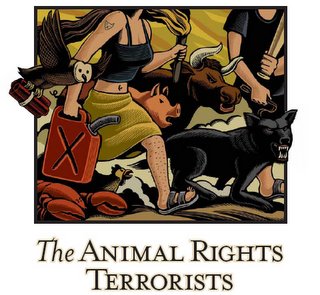
In this strange, distorted interpretation of Orwell’s Animal Farm, activists have apparently succeeded in training all the other animals—cattle, pigs, chickens, owls and an incredible land lobster—to fight for their own liberation without needing to be physically controlled. The beasts’ facial expressions are of anger, outrage and resolve: they know what they are doing, their crimes premeditated. The owl is so gung-ho that she’s carrying a clutch of dynamite in her talons, and, significantly, the pig actually seems to be flying. (If the NRA opposes evolution, this might be the reason.)

Even though the picture is pure fantasy, I think it is an accurate rendering of the NRA’s deepest fears: that the future holds wild packs of pissed-off animals roaming the post-McDonald’s® wasteland seeking vengeance against their bipedal oppressors. Obviously, once animals are freed, they will murder and enslave humans in retribution: an apocalyptic twist on  the old adage that if we didn’t hunt, eat, experiment on and otherwise torture and kill animals, they’d die of starvation and (I guess) inability or unwillingness to breed.

In the context of this booklet, this picture is clearly meant to scare readers by painting a dark portrait of animal rights activists as “terrorists”: they are, after all, carrying explosives and other implements of destruction (to presumably blow up a vivisection lab, factory farm and Red Lobster® franchise, in that order). Yet looking past the violent overtones, this is a somewhat inspirational and iconic image that uniquely captures (however inadvertently) something of the movement’s essence: that is, the animals are fighting, as equals alongside humans, for their rights. If only this reflected reality, we could end humanity’s enslavement of other species within a generation.

“Freedom’s Enemies”

The text mirrors the distorted conception of animal rights activists depicted in the illustration by lumping all animal rights organizations—from the most mainstream to the most radical—into one category, seamlessly morphing from Constitutionally-protected activism to the most hard-core “terrorist” activities in a single sentence:

“(Animal rights groups) run commercials, print propaganda, stage rallies, infiltrate schools with animal rights material, blow up medical labs, burn down buildings, destroy hunters’ property and poison hunters’ dogs—with enough left over to hire top-dollar lawyers if they get caught.”

The drawing of a Molotov cocktail, some pipe bombs, and an envelope with a razor blade inside sitting in a pool of blood is supposed to be straight out of PETA’s toolbox:

“PETA is linked to a growing network of embedded cells of dangerous people willing to achieve their ends through violence... Many don’t know that PETA wants much more than to take a fishing pole from every child’s hand, take away their pet cats and dogs, ban milk from their breakfast, and shut down all their circuses, zoos and aquariums. PETA wants much more than to take Seeing Eye dogs away from the blind, and take bomb-sniffing dogs away from our airports. PETA wants to stop all medical advancements that use animal research in any way… (Research scientists) receive hate mail, letters loaded with razor blades and rat poison, death threats and bomb threats.”

It seems that America’s precious children are in grave danger of growing up in a world where they might question whether it is ethical to hunt, own or eat animals. Even the great tradition of imprisoning animals and forcing them to perform for our amusement is at stake. The great news for the animal rights movement is that, according to the NRA, we are winning: collectively, animal protection groups comprise a “frightening force” that has already been incredibly effective in achieving our nefarious aims:

“Medical research on the verge of breakthrough screeches to a halt. Our most promising labs are shut down…The antihuman, pro-animal frontal assault is broad and pervasive, spanning from political initiatives to indoctrination of schoolchildren to hunter harassment.”

The “Animal Rights Terrorists” section concludes with a plea “that patriots of financial position pledge to stand with freedom’s fighters forevermore.” Which is the whole point of this booklet, actually. In an introduction called “The Coming Confrontation” on page 3, the NRA’s Executive Vice President and Executive Director claims:

“(The) NRA is the only guaranteed investment for Second Amendment survival, as well as for all the business benefits that come with it. Only the NRA energizes the powerful pro-freedom voting bloc, resulting in election outcomes good for both American gun rights and for American business. Candidates who support the Second Amendment also support you. They're typically pro-business people who fight for free-market issues, from tort and estate tax reform to immigration policy and the global war on terror.... The Second Amendment needs freedom-loving financiers on her side, or she will be drowned in the tsunami of cash flowing from freedom's enemies."

The Real Terrorists

Conspicuously absent from the NRA’s rogues’ gallery of supervillains is al-Qaeda, the global ultraterrorist organization that destroyed the World Trade Center with hijacked airliners, killing thousands of people. You’d think they might have at least merited a chapter called “The Suicide Bombers” or “Allah’s Demonic Army” or something. Interestingly, 9/11 is mentioned only once throughout “Freedom In Peril,” and only in passing.

It’s surprising that the NRA doesn’t take these terrorists seriously. Branding peaceful, nonviolent, law-abiding, and civil-disobedient animal rights protesters as “terrorists” only serves to minimize the real dangers the public faces from actual terrorists, as well as from pro-NRA militias that stockpile weapons but go unchecked by the FBI. Instead, as the booklet points out, the FBI itself has identified “animal rights terrorists” as the number one domestic threat to the U.S., even though animal activists have not caused a single person’s death.

The NRA wholly supports the Bush Administration’s War on Terror in that, like those who framed and passed the Animal Enterprise Terrorism Act (AETA), they define animal rights activists across the board as “terrorists” because we endanger the profits of corporations that exploit animals. “It’s inevitable that terrorists will infest America for generations to come,” they say, as though we are termites and the NRA is the exterminator. It is definitely ironic that a group whose main mission is to promote the use of deadly weapons calls people working to stop violence “terrorists”—and sad that their sensationalistic attacks have so often succeeded.

“The U.N… (has) already been successful in orchestrating gun bans in once-free countries like England, Australia, Canada and South Africa,” the pamphlet says. So, in the NRA's alternate-reality universe anyway, South Africa was free under Apartheid, which preceded the gun ban in the country, just because everyone could get guns (well, white people, at least). The NRA is especially fond of spreading the myth that banning guns will provoke more violent crimes. Yet guns kill more than 30,000 people a year in the U.S., and Americans are three times as likely as Canadians to be fatally shot. A new Harvard study shows that higher homicide rates occur in states with more gun owners. But it doesn’t matter to the NRA. Danger and death are simply the price Americans must pay for living in a still-free country where the Second Amendment reigns supreme.

Our country faces real threats: global warming, wars (in Afghanistan, Iraq and possibly Iran), corporate hegemony, income inequality, the national debt, a crumbling education system, institutionalized racism and sexism, the Standard American Diet, etc., etc. Instead of recognizing these problems, the NRA creates boogie monsters to distract attention from issues that actually matter. Their hateful invective against all those who challenge their belief system seems like some symptom of collective mental illness.

Cold Dead Hands

Despite the costs, the ideologues at the NRA cling to their fundamentalist interpretation of the Second Amendment: that it means no gun control at all—period. In contrast, most Americans believe that, alongside the “right” to bear arms, we have a more primary right to be safe from violence, and greater gun control would make us safer. Governments have a responsibility to protect their citizens from danger, and most Americans favor limits on gun ownership and use. In a 2004 Gallup poll, 54% of respondents wanted gun laws to be stricter, compared to only 11% who said they should be less strict.

The pamphlet says: “In the minds of those who framed our Constitution, the right to armed self-protection in times of pandemonium was so obvious and innate that it didn’t warrant mention.” In other words, the less the Constitution has to say about something, the more essential it must be to our way of life. Yeah—that makes sense.

It continues: “That’s why the Second Amendment is brief in language but broad in scope, serving as umbrella protection for lawful use of arms in almost any circumstance.” In NRA-speak, that means gun owners have the right to shoot people whenever they personally determine it's justified. One may wonder: what are the limits of these circumstances? Do they include shooting those who challenge strict adherence to a radical interpretation of the Second Amendment?

Such questions are moot to the NRA because they are militantly inflexible about their “right” to own and use guns without restrictions. They are also trying to preserve a way of life that kills people and animals while placeing corporate interests above society's. Part of their intent is to redefine freedom so that it means the freedom to make money from the blood of innocent animals and to make a financial killing selling guns. Firearms are a global multibillion-dollar a year enterprise, one of the biggest moneymaking operations on the planet. The NRA’s connection to the international arms industry gives them a huge financial stake in stopping gun control efforts in the U.S. and abroad.

The political system runs too much these days on money and backroom business deals rather than ethics or trying to improve the state of the world. Increasingly, the pursuit of our “national interest” is becoming the unquestioned protection of corporate profits against any criticism. The NRA and other fanatical pro-business groups will continue to fight for their “right” to go on harming people, animals and the environment, even though in doing so they are violating the rights of billions.

Happiness is a Warm Gun

As one of the world’s most powerful lobbying organizations, the four-million-member NRA has so far been able to block almost all legislative efforts to regulate guns. They literally see themselves as the “guardians” not only of the Second Amendment but of freedom itself. In fact, they believe that without unfettered access to guns, Americans would swiftly lose all of our other freedoms.

Yet in the narrative of “Freedom In Peril,” the NRA (oddly enough) consistently portrays gun owners as helpless victims. All the “good” people in the pictures are fighting a losing battle, under siege by insurmountable forces. The NRA argues that guns will protect our freedom when the time comes. But in this booklet that time has actually come, and guns are shown to be completely useless.

Think about it: What good is granny’s handgun supposed to do against seven commandos with automatic weapons (page 13)? (Incidentally, this illustration is allegedly based on an actual event that took place in post-Katrina New Orleans.) How is a shotgun going to enable that dad perched on his rooftop (page 14) to protect his family from the roving hordes coming up the street filled with overturned cars and burned-out houses? And on the final page, next to the Epilogue, the father seems to have just given up: he’s not even holding a gun, just waiting with his wife and son to be engulfed by the encroaching tidal wave that has crested their driveway.

Obviously, guns cannot protect people from what the NRA seems to believe is coming. Actually, the spread of firearms will only bring about chaos that much quicker. Instead of focusing on causative solutions and preventive measures against society’s collapse, their answer is that everyone should have guns: then we’ll all be safe! The pamphlet warns, “If we do not heed the lesson of Katrina—that survival in disaster is ultimately the responsibility of the individual—the next tragedy will almost certainly include further devastation of American freedoms.”

This directly denies that the government has any responsibility to help its citizens during disasters. It also clearly states the NRA’s core philosophy: that it is every man for himself in this world, especially in times of crisis, so you’d better be packing serious heat if you expect to survive. The NRA embodies the “You’re either with us or with the terrorists” mentality that came into vogue with the post-9/11 posturing of Bush & Co. If you support gun control, then you’re not with the NRA; therefore, by this simplistic and flawed logic, you must be against them and therefore a “terrorist.”

Now What?

The NRA has held a stony silence on the story behind “Freedom In Peril.”** Some commentators speculate that it was intended as a mailer to the group’s rank-and-file, but it seems more likely that it was designed as a special fundraising tool to target wealthy donors. The book's epilogue concludes that “victory can no longer be borne solely by the masses,” which means they’re fishing for more than just $25 yearly donations. If they are scaring people without just cause merely as a cynical ploy for money, then they are insulting their constituency, whether it’s Joe Sixpack or Billy Bob Billionaire. What is scarier is the thought that this isn’t all about money, and that the heads of this powerful organization actually believe we’re on the verge of an all-out social collapse or apocalypse — and that guns, of all things, are the solution.

I hold out hope that this pamphlet doesn’t represent the viewpoint of the majority of NRA members, and that most will be offended by it. Some may revoke their memberships, perhaps realizing the need for a less extreme pro-gun organization that sees the logic in regulations. A blogger and gun owner named Buffalo wrote: “My respect for the NRA decreased to almost nil when I read the pamphlet… This piece of crap tarnishes their image and should shame them.”

For all the talk about firearms, the key issue “Freedom In Peril” raises for the movement is not necessarily the question of gun control, but rather the ubiquitous spread of the perception that animal rights advocates are—by definition—terrorists. We need to counter this stereotype, but in order to do that we must thoroughly understand how our opponents think. “Freedom In Peril” is therefore something of a gift to the animal rights community because it so blatantly lays out how some of the most extreme extremists perceive us. I think it bears very close study.

What would be really amazing is if the animal rights movement could produce something as visually compelling as “Freedom In Peril.” If there are any great artists out there who are interested in collaborating on something like this, please contact me at mathomas@gmail.com.


* It must be noted that the graphic-novelesque design and artwork for this booklet by Arizona-based draftsman Chris Gall are of the highest quality almost throughout, but this is one of my favorite drawings. Given his plethora of high-powered clients and awards, I am curious whether Gall believes the NRA’s ideology or is just prostituting his formidable talent.

** I did a search for “Freedom In Peril” on the NRA website thinking I would find something that tells their side of the story, but instead got a “0 document(s) retrieved” message. So the NRA is basically pretending this brochure doesn’t even exist, and hoping that this will all blow over soon if they just lay low for awhile. Clearly they are embarrassed about being so exposed. (It must be noted that I conducted the same search on the PETA and HSUS websites and came up with zero results, as well.)

Links:

Here are some of the articles and blogs I read in researching this story:

NRA Pamphlet: “Freedom in Peril: Guarding the 2nd Amendment in the 21st Century”

NRA's Graphic Attack on Its Enemies Leaked Onto Internet

NRA already taking shots at the incoming Democratic Congress

NRA Sounds Alarms on Gun Control

The Infidel Sage

Streich(er) One

YOUR NEW REALITY: Weapons Of Mass Information

Wonkette: NRA's Secret Graphic Novel Revealed!

Boing Boing

NRA comic called a hoax, but accusations later withdrawn

NRA Sounds Alarm of Not-So-Imminent Threat

Matthew High

NRA's Purloined Pamphlet Seeks Support of Big Business

AnonymousLefty

Gun Guys