Dream of Monday morning, May 8th, 2006: An Illustrated History of Punk
I was sleeping in a bed in the large glass lobby of my grandmother’s apartment building in Manhattan. This was my mother's mother (who, in real life, died in 2004). My mother and older brother Andy entered the lobby and started talking. I remained lying down under the covers, still half asleep, but opened my eyes a little. It was night time, and the lights of the city shone in through the wall-to-wall windows. Mom and Andy discussed my grandfather, who they were going to visit in the hospital. He was my father’s father (who, in real life, died over twenty years ago), but he was married to my mother’s mother, whose apartment building we were in. He was expected to die that night, and their conversation concerned making preparations for what they would have to do afterward, dealing with the body and other practical concerns.
I half hoped that Andy and my mom would wake me: I wanted to feel needed, useful. The other half of me hoped they would leave me alone because I really didn’t want to face the disturbing reality of the hospital and witnessing my grandfather’s death. I was feeling regressive, childlike, wanting to avoid the responsibilities and burdens of adulthood. I realized that it was immature of me to sleep in and not volunteer to help, but I was still quite sleepy, so it would have taken some mental and physical effort to get out from under the covers and enter the cold night. They left for the hospital without disturbing me or even referring to me.
Still half asleep, I started watching a television that was turned on in the lobby. On it was a documentary called
An Illustrated History of Punk. The first segment took place on a variety show around 1972: I could tell by the fashions and the grainy, washed-out quality of the film. It was the kind of program that might feature plate spinners, schlocky comedians in checkered sportcoats, and family novelty acts.
The MC introduced a performer who walked out on stage. He was a musician, a thin white guy of average height with a short, well-groomed beard, straight light brown hair with bangs that was somewhat longer in the back, very intense dark eyes and a sneaky, secretive smile. He wore a ragged, tight-fitting charcoal gray jacket with light gray stripes around the elbows and shoulders. He performed an outrageous punk song, somehow producing the dissonant music all by himself even though I cannot remember him having an instrument. He more or less jumped around the stage singing into a microphone with a cord accompanied by music that sounded something like a cross between Cat Stevens and the Sex Pistols. When he finished, he smiled serenely as the host stood aghast, open-mouthed in wordless indignation. From the audience came a few angry shouts, women crying, and general fury: it seemed like the crowd might be on the verge of a collective nervous breakdown or a riot.
Then the scene cut to an old hotel lobby exhibition of punk art. Though there was a lot of really bizarre stuff on display, the only visual I remember was a fountain, the centerpiece of which was a large ceramic sculpture of a white frog with green trim around the eyes and legs. Thick, dark yellow pus flowed from the frog’s mouth into a little stream that ran offscreen to the right. I said to myself in the dream, I’ll have to remember to rent this documentary on DVD sometime and watch it from the beginning.
Watching the film while lying in my dream bed (while asleep in my actual bed) made me remember why I have been so drawn to punk since I was a teenager: our society is so fundamentally fucked up, so deeply corrupt, that choosing to protest by withdrawing one’s participation and support from a fraudulent and violent system is a legitimate choice and a valid matter for ethical consideration. These thoughts came to me with an overwhelming rush of intensity in the dream itself and have remained with me.
As I was lying on my side with my head on a pillow watching the documentary, my grandmother came back from the hospital and sat at the foot of my bed. She was wearing a smart, bright-purple skirt and double-breasted jacket with large gold buttons, and she was smiling, beaming in fact. She was radiant, illuminated, and happier than I’d ever seen her in real life. She told me that her husband’s imminent death had made her realize how precious life is, and awakened in her a passion for living that she had not known since youth. She said that there were many things she wanted to experience and enjoy in the time left to her. I was overcome with tears of joy and woke from the dream.
It took me a minute or so to transition from dreaming to consciousness, during which time I held on to the emotional experience of the dream. I felt as though I had been visited by my grandmother’s spirit, and that she had brought me an important message about living life to the fullest. This was also, in a different way, the meaning I took from the punk documentary, which stayed with me as I rose from bed to start my day and write IDA's e-newsletter. It was definitely relevant to the work that I was about to do.
Specifically, any philosophy of resistance must offer a viable alternative that is more than merely a negation or rejection of the status quo: it must be a path to truth. One cannot overcome the pull toward conventional life merely by rebelling against it, as that becomes another form of hopeless conformity. Rather, one needs to create an authentic life, through constant focused effort, that is beyond the very rules of society. Of course, while this may be an actual possibility, it is insanely difficult. Yet it is what I strive for as an animal advocate, and to the extent that I miss the mark, at least I have come closer to it than I would have if I decided to participate mindlessly in humanity's vicious killing cycle or to remain conspicuously silent about it by not writing.
Guns N’ Roses – Carol Adams dream
This reminds me of another dream I had at the Animal Rights 2003 conference in Los Angeles over two years ago.
There was quite a controversy at the conference that year about women’s role and participation in the movement. The previous year, Howard Lyman had apparently made an offhand comment about some fashion model representing “the shape of the movement” or something, and feminists took offense. This also raised issues about representation of women’s views at the conference: feminists charged that women were not taken seriously by the male conference organizers who made undemocratic decisions about who was to present what subjects.
Carol Adams, author of
The Sexual Politics of Meat and other seminal books about feminism and animal rights (pictured with me at the conference),
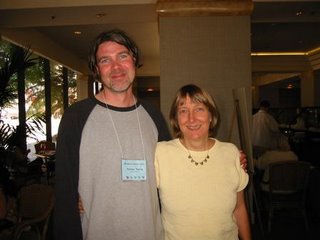
distributed flyers inviting conference attendees to a late-night cell meeting in the hotel lobby to discuss how feminists could be heard within the movement. Considering myself a strong profeminist at the time, I chose to attend. I was one of three men who went with maybe a dozen women, none of whom I knew. There did seem to be some legitimate concerns about the way the conference organizers treated women presenters, but I did not feel particularly welcome at the discussion.
I suppose that's because of a specific incident. When Carol criticized PETA for using images of semi-naked women to “sell” veganism and animal rights, I asked (being that I was working in marketing at the time) whether anyone had studied the effectiveness of this approach. There was a moment of silence during which Carol stared at me with a look of utter contempt, then turned back to the group and continued the discussion without acknowledging my comment. I sat in for awhile longer, but felt degraded and didn’t open my mouth again. Neither did I speak to Carol after that during the rest of the conference. That was disappointing, because I liked Carol, had read several of her books, and felt there was a lot I could learn from her. It wasn’t her fault: I guess I'm just easily bruised.
I emailed Carol in September 2006 about this blog entry, and her response did have something to say about my question:
"Academically speaking: do the ads work, is an interesting question, and actually, since that time, I met a feminist undergraduate who did some focus groups using PETA ads and she found out that no, they don't work. But, activist-ly speaking (pardon the coining of a term), do they work? is immaterial, because they are built on the oppression of women."
I now completely understand and agree with this perspective, having learned in my few years of animal advocacy that there is more to ethics and efficacy than meets the eye. But then I'm partial to old-school feminist theory, and suspect that feminism today too often masquerades in the guise of feminine sexual power. That is, women who fit contemporary society's version of beauty and are willing to expose their bodies on camera do weild a certain amount of influence in the world, and there are countless women competing to take advantage of that. However, rather than possessing the social cache to actually change someone's ethical worldview, these sex symbols mainly have the power to sell beer, cars and Axe cologne.
Sex cannot "sell" animal rights, convenient though it might be to assume it would. Even if it somehow could, I would still not support it. Making animal rights sexy is one thing, most likely a good thing, but making people into sex objects or objectifying sex itself to achieve that end is wrong, and damaging to both women and men.
The question of whether a woman who chooses to express her sexuality as part of a media blitz actually still owns her sexual self is open to debate, for the naked female body becomes a commodity as soon as it enters the marketplace of images and ideas. Members of the target demographic probably don't care at that point that the presented body is occupied by a conscious person who is aware of herself and her infinite, unique complexity: what matters to these individuals is that the images can be sexually consumed and set aside at will. Animal rights is at best the second thing on the mind of an average guy who stumbles on a PETA ad: the majority of his attention will be drawn to the T&A on display.
Anyway, putting such controversial debate aside for the moment, I had the following dream at 6:00 a.m. on August 6th, 2003 in my room at the Westin LAX hotel in Los Angeles on the last day of the Animal Rights 2003 conference:
I was watching an episode of a new TV series that was a fictionalized history of Guns N’ Roses. It took place in the late 80s, and during a break in their tour schedule the band walked around a very futuristic looking Los Angeles. Everyone in the city wore ridiculous Guns 'n Roses-inspired fashions, like snakeskin trenchcoats, and had big, thickly gelled heavy metal hair. The band members went into a bar: everything about them was very stylized, airbrushed for TV. Axl was smiling, not a stubble out of place, talking to someone on a payphone. The people, the city, the bar were obviously phony, constructed not as a place for people to live, but to serve only as TV scenery. The extras were choreographed to make it seem as though they were real people walking around, but their stiff, precise movements were too mechanical to look authentic.
Slash had booked the tour and was in charge of the money. He showed the band where they'd be staying: tents made out of blankets and rope in a field of dry yellow grass. Axl complained, accusing Slash of having spent all the money on fancy dinners for himself, so that now they couldn't afford a hotel. The area where the tents were set up was a different part of the city from the TV set: this was where all the poor people lived, mostly people of color. It was something like a barrio, a shantytown, and felt much more real than the other part of the city.
A local a cappella group of about a dozen white people, evenly split between men and women, performed a special honorary concert for Guns ‘N Roses. A small audience gathered. The group members stood lined up on stage in four rows of three, men on the left, women on the right. Their bodies all faced the same direction: to the spectators' left, yet they turned their faces toward the audience. They wore what looked like gender-specific barbershop quartet uniforms: the men in striped shirts with bowties and suspenders, the women in frilly white blouses. They sang a traditional song in harmony unaccompanied by musicians.
Soon, they sang a line at the end of which the men used a slightly different word than did the women. The women tried to keep the song going despite the obvious mistake, but the men stopped to explain, in mumbling disarray, that this always happened: they, the men, sang the line correctly, in accordance with tradition, and the women always sang the wrong word. A few of the women subtly rolled their eyes and sighed, but did not speak. However, I knew the way the song was supposed to be sung, and the women were singing it accurately: the men just didn't realize it and were way too sure of their own superiority to even consider that they might be mistaken. Yet they went on believing that their way of singing the song was the right and only way, even though the women were actually singing the correct lyric.
I was amazed upon waking that my subconscious could pull this symbolic story out of my actual experiences at the conference. I felt I understood what Carol and the other feminists were feeling. Perhaps still fearing rejection, it took me three years to send her the dream.