Monday, January 15, 2007

Leaked NRA Pamphlet Targets “Animal Rights Terrorists”

"You can have my gun when you pry it from my cold, dead hands!"
- Former NRA President and Oscar-winning actor Charlton Heston

On December 22nd, a blog called Wonkette.com posted a leaked 27-page fundraising booklet that they said had been produced by the National Rifle Association (NRA). It was such a bizarre piece of propaganda that many thought it a hoax. However, the pamphlet soon proved to be the genuine article—a highly polished draft of “Freedom In Peril: Guarding the 2nd Amendment in the 21st Century”—mysteriously “stolen” from an NRA office.

This NRA pamphlet casts the world’s fate in highly alarmist tones, warning of an imminent and violent clash between a conspiracy of “evil” forces on one side and God-fearing, law-abiding gun owners on the other. The dreaded result: forced disarmament of the entire country, and thus total and irrevocable loss of Freedom, Democracy and Civilization. The NRA’s terrifying demons include shadowy Democrats and their Zionist financiers, mushy-headed “One World Extremists” who want to surrender America to the United Nations, subversive celebrities like Rosie O’Donnell and Katie Couric, the liberal media as a giant devil head coming through the TV screen, and even “Illegal Alien Gangs” of menacing minorities making cryptic hand signs. And, of course, there are also “The Animal Rights Terrorists,” among which are PETA, HSUS and the Fund for Animals.

“The Animal Rights Terrorists”

One can first infer the crimes of the “animal rights terrorists” from the amazing illustration* on page 18, which provides a fascinatingly rich level of visual detail and a priceless glimpse into the minds of NRA leaders. The image is fertile with secret symbols, hidden meanings and subliminal messages.

In the foreground strides a hairy-legged, Birkenstock-wearing hippie gal carrying a flaming torch and a can of gasoline. She sports a tattoo on her arm that has been described in the blogosphere as “a kitty-cat Satan” or “a kitler, a cat that looks like Hitler.” She is cut off at the neck (implying that these underground agitators are able to hide their faces and identities), and her male co-conspirator wields a baseball bat and a snarling black dog on a leash.

In this strange, distorted interpretation of Orwell’s Animal Farm, activists have apparently succeeded in training all the other animals—cattle, pigs, chickens, owls and an incredible land lobster—to fight for their own liberation without needing to be physically controlled. The beasts’ facial expressions are of anger, outrage and resolve: they know what they are doing, their crimes premeditated. The owl is so gung-ho that she’s carrying a clutch of dynamite in her talons, and, significantly, the pig actually seems to be flying. (If the NRA opposes evolution, this might be the reason.)

Even though the picture is pure fantasy, I think it is an accurate rendering of the NRA’s deepest fears: that the future holds wild packs of pissed-off animals roaming the post-McDonald’s® wasteland seeking vengeance against their bipedal oppressors. Obviously, once animals are freed, they will murder and enslave humans in retribution: an apocalyptic twist on  the old adage that if we didn’t hunt, eat, experiment on and otherwise torture and kill animals, they’d die of starvation and (I guess) inability or unwillingness to breed.

In the context of this booklet, this picture is clearly meant to scare readers by painting a dark portrait of animal rights activists as “terrorists”: they are, after all, carrying explosives and other implements of destruction (to presumably blow up a vivisection lab, factory farm and Red Lobster® franchise, in that order). Yet looking past the violent overtones, this is a somewhat inspirational and iconic image that uniquely captures (however inadvertently) something of the movement’s essence: that is, the animals are fighting, as equals alongside humans, for their rights. If only this reflected reality, we could end humanity’s enslavement of other species within a generation.

“Freedom’s Enemies”

The text mirrors the distorted conception of animal rights activists depicted in the illustration by lumping all animal rights organizations—from the most mainstream to the most radical—into one category, seamlessly morphing from Constitutionally-protected activism to the most hard-core “terrorist” activities in a single sentence:

“(Animal rights groups) run commercials, print propaganda, stage rallies, infiltrate schools with animal rights material, blow up medical labs, burn down buildings, destroy hunters’ property and poison hunters’ dogs—with enough left over to hire top-dollar lawyers if they get caught.”

The drawing of a Molotov cocktail, some pipe bombs, and an envelope with a razor blade inside sitting in a pool of blood is supposed to be straight out of PETA’s toolbox:

“PETA is linked to a growing network of embedded cells of dangerous people willing to achieve their ends through violence... Many don’t know that PETA wants much more than to take a fishing pole from every child’s hand, take away their pet cats and dogs, ban milk from their breakfast, and shut down all their circuses, zoos and aquariums. PETA wants much more than to take Seeing Eye dogs away from the blind, and take bomb-sniffing dogs away from our airports. PETA wants to stop all medical advancements that use animal research in any way… (Research scientists) receive hate mail, letters loaded with razor blades and rat poison, death threats and bomb threats.”

It seems that America’s precious children are in grave danger of growing up in a world where they might question whether it is ethical to hunt, own or eat animals. Even the great tradition of imprisoning animals and forcing them to perform for our amusement is at stake. The great news for the animal rights movement is that, according to the NRA, we are winning: collectively, animal protection groups comprise a “frightening force” that has already been incredibly effective in achieving our nefarious aims:

“Medical research on the verge of breakthrough screeches to a halt. Our most promising labs are shut down…The antihuman, pro-animal frontal assault is broad and pervasive, spanning from political initiatives to indoctrination of schoolchildren to hunter harassment.”

The “Animal Rights Terrorists” section concludes with a plea “that patriots of financial position pledge to stand with freedom’s fighters forevermore.” Which is the whole point of this booklet, actually. In an introduction called “The Coming Confrontation” on page 3, the NRA’s Executive Vice President and Executive Director claims:

“(The) NRA is the only guaranteed investment for Second Amendment survival, as well as for all the business benefits that come with it. Only the NRA energizes the powerful pro-freedom voting bloc, resulting in election outcomes good for both American gun rights and for American business. Candidates who support the Second Amendment also support you. They're typically pro-business people who fight for free-market issues, from tort and estate tax reform to immigration policy and the global war on terror.... The Second Amendment needs freedom-loving financiers on her side, or she will be drowned in the tsunami of cash flowing from freedom's enemies."

The Real Terrorists

Conspicuously absent from the NRA’s rogues’ gallery of supervillains is al-Qaeda, the global ultraterrorist organization that destroyed the World Trade Center with hijacked airliners, killing thousands of people. You’d think they might have at least merited a chapter called “The Suicide Bombers” or “Allah’s Demonic Army” or something. Interestingly, 9/11 is mentioned only once throughout “Freedom In Peril,” and only in passing.

It’s surprising that the NRA doesn’t take these terrorists seriously. Branding peaceful, nonviolent, law-abiding, and civil-disobedient animal rights protesters as “terrorists” only serves to minimize the real dangers the public faces from actual terrorists, as well as from pro-NRA militias that stockpile weapons but go unchecked by the FBI. Instead, as the booklet points out, the FBI itself has identified “animal rights terrorists” as the number one domestic threat to the U.S., even though animal activists have not caused a single person’s death.

The NRA wholly supports the Bush Administration’s War on Terror in that, like those who framed and passed the Animal Enterprise Terrorism Act (AETA), they define animal rights activists across the board as “terrorists” because we endanger the profits of corporations that exploit animals. “It’s inevitable that terrorists will infest America for generations to come,” they say, as though we are termites and the NRA is the exterminator. It is definitely ironic that a group whose main mission is to promote the use of deadly weapons calls people working to stop violence “terrorists”—and sad that their sensationalistic attacks have so often succeeded.

“The U.N… (has) already been successful in orchestrating gun bans in once-free countries like England, Australia, Canada and South Africa,” the pamphlet says. So, in the NRA's alternate-reality universe anyway, South Africa was free under Apartheid, which preceded the gun ban in the country, just because everyone could get guns (well, white people, at least). The NRA is especially fond of spreading the myth that banning guns will provoke more violent crimes. Yet guns kill more than 30,000 people a year in the U.S., and Americans are three times as likely as Canadians to be fatally shot. A new Harvard study shows that higher homicide rates occur in states with more gun owners. But it doesn’t matter to the NRA. Danger and death are simply the price Americans must pay for living in a still-free country where the Second Amendment reigns supreme.

Our country faces real threats: global warming, wars (in Afghanistan, Iraq and possibly Iran), corporate hegemony, income inequality, the national debt, a crumbling education system, institutionalized racism and sexism, the Standard American Diet, etc., etc. Instead of recognizing these problems, the NRA creates boogie monsters to distract attention from issues that actually matter. Their hateful invective against all those who challenge their belief system seems like some symptom of collective mental illness.

Cold Dead Hands

Despite the costs, the ideologues at the NRA cling to their fundamentalist interpretation of the Second Amendment: that it means no gun control at all—period. In contrast, most Americans believe that, alongside the “right” to bear arms, we have a more primary right to be safe from violence, and greater gun control would make us safer. Governments have a responsibility to protect their citizens from danger, and most Americans favor limits on gun ownership and use. In a 2004 Gallup poll, 54% of respondents wanted gun laws to be stricter, compared to only 11% who said they should be less strict.

The pamphlet says: “In the minds of those who framed our Constitution, the right to armed self-protection in times of pandemonium was so obvious and innate that it didn’t warrant mention.” In other words, the less the Constitution has to say about something, the more essential it must be to our way of life. Yeah—that makes sense.

It continues: “That’s why the Second Amendment is brief in language but broad in scope, serving as umbrella protection for lawful use of arms in almost any circumstance.” In NRA-speak, that means gun owners have the right to shoot people whenever they personally determine it's justified. One may wonder: what are the limits of these circumstances? Do they include shooting those who challenge strict adherence to a radical interpretation of the Second Amendment?

Such questions are moot to the NRA because they are militantly inflexible about their “right” to own and use guns without restrictions. They are also trying to preserve a way of life that kills people and animals while placeing corporate interests above society's. Part of their intent is to redefine freedom so that it means the freedom to make money from the blood of innocent animals and to make a financial killing selling guns. Firearms are a global multibillion-dollar a year enterprise, one of the biggest moneymaking operations on the planet. The NRA’s connection to the international arms industry gives them a huge financial stake in stopping gun control efforts in the U.S. and abroad.

The political system runs too much these days on money and backroom business deals rather than ethics or trying to improve the state of the world. Increasingly, the pursuit of our “national interest” is becoming the unquestioned protection of corporate profits against any criticism. The NRA and other fanatical pro-business groups will continue to fight for their “right” to go on harming people, animals and the environment, even though in doing so they are violating the rights of billions.

Happiness is a Warm Gun

As one of the world’s most powerful lobbying organizations, the four-million-member NRA has so far been able to block almost all legislative efforts to regulate guns. They literally see themselves as the “guardians” not only of the Second Amendment but of freedom itself. In fact, they believe that without unfettered access to guns, Americans would swiftly lose all of our other freedoms.

Yet in the narrative of “Freedom In Peril,” the NRA (oddly enough) consistently portrays gun owners as helpless victims. All the “good” people in the pictures are fighting a losing battle, under siege by insurmountable forces. The NRA argues that guns will protect our freedom when the time comes. But in this booklet that time has actually come, and guns are shown to be completely useless.

Think about it: What good is granny’s handgun supposed to do against seven commandos with automatic weapons (page 13)? (Incidentally, this illustration is allegedly based on an actual event that took place in post-Katrina New Orleans.) How is a shotgun going to enable that dad perched on his rooftop (page 14) to protect his family from the roving hordes coming up the street filled with overturned cars and burned-out houses? And on the final page, next to the Epilogue, the father seems to have just given up: he’s not even holding a gun, just waiting with his wife and son to be engulfed by the encroaching tidal wave that has crested their driveway.

Obviously, guns cannot protect people from what the NRA seems to believe is coming. Actually, the spread of firearms will only bring about chaos that much quicker. Instead of focusing on causative solutions and preventive measures against society’s collapse, their answer is that everyone should have guns: then we’ll all be safe! The pamphlet warns, “If we do not heed the lesson of Katrina—that survival in disaster is ultimately the responsibility of the individual—the next tragedy will almost certainly include further devastation of American freedoms.”

This directly denies that the government has any responsibility to help its citizens during disasters. It also clearly states the NRA’s core philosophy: that it is every man for himself in this world, especially in times of crisis, so you’d better be packing serious heat if you expect to survive. The NRA embodies the “You’re either with us or with the terrorists” mentality that came into vogue with the post-9/11 posturing of Bush & Co. If you support gun control, then you’re not with the NRA; therefore, by this simplistic and flawed logic, you must be against them and therefore a “terrorist.”

Now What?

The NRA has held a stony silence on the story behind “Freedom In Peril.”** Some commentators speculate that it was intended as a mailer to the group’s rank-and-file, but it seems more likely that it was designed as a special fundraising tool to target wealthy donors. The book's epilogue concludes that “victory can no longer be borne solely by the masses,” which means they’re fishing for more than just $25 yearly donations. If they are scaring people without just cause merely as a cynical ploy for money, then they are insulting their constituency, whether it’s Joe Sixpack or Billy Bob Billionaire. What is scarier is the thought that this isn’t all about money, and that the heads of this powerful organization actually believe we’re on the verge of an all-out social collapse or apocalypse — and that guns, of all things, are the solution.

I hold out hope that this pamphlet doesn’t represent the viewpoint of the majority of NRA members, and that most will be offended by it. Some may revoke their memberships, perhaps realizing the need for a less extreme pro-gun organization that sees the logic in regulations. A blogger and gun owner named Buffalo wrote: “My respect for the NRA decreased to almost nil when I read the pamphlet… This piece of crap tarnishes their image and should shame them.”

For all the talk about firearms, the key issue “Freedom In Peril” raises for the movement is not necessarily the question of gun control, but rather the ubiquitous spread of the perception that animal rights advocates are—by definition—terrorists. We need to counter this stereotype, but in order to do that we must thoroughly understand how our opponents think. “Freedom In Peril” is therefore something of a gift to the animal rights community because it so blatantly lays out how some of the most extreme extremists perceive us. I think it bears very close study.

What would be really amazing is if the animal rights movement could produce something as visually compelling as “Freedom In Peril.” If there are any great artists out there who are interested in collaborating on something like this, please contact me at mathomas@gmail.com.


* It must be noted that the graphic-novelesque design and artwork for this booklet by Arizona-based draftsman Chris Gall are of the highest quality almost throughout, but this is one of my favorite drawings. Given his plethora of high-powered clients and awards, I am curious whether Gall believes the NRA’s ideology or is just prostituting his formidable talent.

** I did a search for “Freedom In Peril” on the NRA website thinking I would find something that tells their side of the story, but instead got a “0 document(s) retrieved” message. So the NRA is basically pretending this brochure doesn’t even exist, and hoping that this will all blow over soon if they just lay low for awhile. Clearly they are embarrassed about being so exposed. (It must be noted that I conducted the same search on the PETA and HSUS websites and came up with zero results, as well.)

Links:

Here are some of the articles and blogs I read in researching this story:

NRA Pamphlet: “Freedom in Peril: Guarding the 2nd Amendment in the 21st Century”

NRA's Graphic Attack on Its Enemies Leaked Onto Internet

NRA already taking shots at the incoming Democratic Congress

NRA Sounds Alarms on Gun Control

The Infidel Sage

Streich(er) One

YOUR NEW REALITY: Weapons Of Mass Information

Wonkette: NRA's Secret Graphic Novel Revealed!

Boing Boing

NRA comic called a hoax, but accusations later withdrawn

NRA Sounds Alarm of Not-So-Imminent Threat

Matthew High

NRA's Purloined Pamphlet Seeks Support of Big Business

AnonymousLefty

Gun Guys

Wednesday, January 10, 2007

Volunteer to Help Animals on MLK Day

Join millions of others in making this holiday "A day ON, not a day OFF"

During his lifetime, the great humanitarian and civil rights leader Dr. Martin Luther King, Jr. established an extraordinary legacy of peacefully pursuing freedom and equality for everyone, regardless of race or ethnicity. The foundation of his life's work was the twin pillars of non-violence and selfless service to others. As a leader of the people, he promoted the creation of mutually-supporting communities that could work together across a broad range of social justice issues to bring about progressive change.

To honor this great American hero, Congress passed the King Holiday and Service Act in 1994, officially designating January 15th as a national day of volunteer service. Every year, millions of people across the country celebrate and commemorate MLK's shining example by taking action with others to address social problems of all kinds. Of the King Day of Service, Dr. King's wife, Coretta Scott King, said "The greatest birthday gift my husband could receive is if people of all racial and ethnic backgrounds celebrated this holiday by performing individual acts of kindness through service to others."

Had Dr. King not been assassinated in 1968, he probably would have followed the compassionate example of Coretta and their oldest son Dexter, who both became vegan for ethical reasons. Dexter, a minister like his father, has been a vegan since 1988, and has called animal rights a "logical extension" of his father's commitment to non-violence. Coretta, who died in January 2006, said that her conversion to veganism in 1995 was "a blessing." Both saw animals as deserving of respect and liberty and made these values an integral part of their daily lives.

Animal advocates can help carry on and extend Dr. King's values by doing something to help animals on January 15th. Just as Dexter and Coretta Scott King clearly recognized that human and animal rights are interconnected, Dr. King would have agreed that brutally exploiting other species is just as wrong as holding a class of people down because of the color of their skin. As he so eloquently said in a watershed 1963 speech that continues to echo in the souls of caring people more than four decades later, "I have a dream that one day…the sons of former slaves and the sons of former slaveowners will be able to sit down together at a table of brotherhood." Were he alive today, Dr. King might add to his dream the hope that one day the human race will end its enslavement of animals for food, clothing, entertainment and experimentation so that all sentient beings can be free to live in peace and harmony.

What You Can Do:

1) The King Day of Service is a wonderful opportunity to help make Dr. King's visionary dream a reality by showing others that respecting animals is a vital expression of the non-violent philosophy MLK stood for. Therefore, please take "A day ON, not a day OFF" on Monday, January 15th by volunteering to do something to help animals. Here are some ideas for activities:
- Bring vegan meals to homebound neighbors or to volunteers who are taking part in King Day of Service activities. Find a list of events scheduled for your area.
- Table or leaflet at a King Day of Service event or at a health fair, or even on a busy street corner in your area.
- Ask your local humane society or animal shelter what you can do to help them on January 15th and throughout the year.

2) If you volunteer or work for an animal protection organization, register to sponsor and organize a single service project or a series of projects to help animals on the King Day of Service.

Thursday, December 21, 2006

Successful Outreach Campaign Prompts Furrier’s Move

Activists to continue outreach and education efforts with community leaders and public

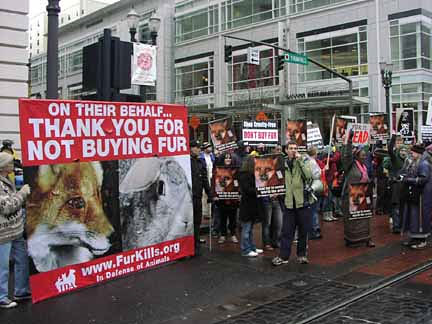
After a year of weekly demonstrations by animal advocates that garnered national attention, fourth-generation fur salon Schumacher Fur and Outerwear is leaving the location it has occupied in downtown Portland, Ore. since 1895. This is a major victory for those who ethically oppose the multi-billion dollar fur industry that every year kills over 40 million minks, foxes, rabbits and other species for clothes and fashion accessories.

The Schumacher campaign started in 2005 on Fur Free Friday, a national event held annually for the last 20 years on the day after Thanksgiving (the busiest shopping day of the year also known as “Black Friday”). That year, some 100 activists turned out for IDA's annual march through downtown Portland, a socially and politically progressive city that is also a hotbed of animal rights activity.

Inspired by this success, a group of grassroots activists began holding demonstrations outside of Schumacher’s every Saturday. Otherwise known as the Schumacher Fur Street Party, the weekly protests were typically attended by dozens of activists in a festive atmosphere replete with costumes, creative signs and camaraderie. Matt Rossell, the Outreach Coordinator for Northwest In Defense of Animals, became the group’s unofficial spokesperson when media started covering the story, drawn by the bizarre antics of store owners Gregg and Linda Schumacher.

For example, the Schumachers, along with their employees and supporters, taunted, threatened, spit on and even assaulted protesters, shoving them and knocking signs from their hands. A Schumacher employee made death threats to a high school teen delivering a speech about the fur industry’s abuse of animals at the store’s doorstep. A sign in their window stated that "All protesters should be Beaten, Strangled, Skinned Alive, Anally Electrocuted and Clubbed." These heavy-handed attempts to drive demonstrators away only amplified their resolve and numbers.

Schumacher complained incessantly to authorities, calling the protesters “terrorists” despite the fact that police witnesses testified that participants were acting within their first amendment rights. The Mayor tapped Rossell to represent the protestors in city-sponsored mediation, but the Schumachers dragged their heels and finally refused to participate after activists proposed labeling fur garments with an accurate description of how animals used to make them are killed. Throughout the year, the media fed on the story, with Rossell reminding them at every turn that the real victims are fur-bearing animals—not the Schumachers, as the couple repeatedly claimed.

Just days after Fur Free Friday 2006, when 200 activists marched through Portland’s streets, the Schumachers announced they were moving to a new location. As activists celebrated, Rossell took a broad view. “The real victory need not be measured in moving sales, because with the global media coverage this outreach campaign generated, the story is not just about a single store or city: it’s about spreading a message of compassion for animals for the whole world to hear,” he said. “IDA will continue promoting a consumer warning tag on all fur sold in Portland, and perhaps even propose a citywide ban of fur sales.”

Learn more at furkills.org.

Wednesday, November 15, 2006

House Passes Animal Enterprise Terrorism Act

Controversial new law could criminalize currently legal activism tactics

Animal advocates around the U.S. were stunned and dismayed on Monday, November 13th when Congress quickly approved the Animal Enterprise Terrorism Act (AETA), a bill that threatens to seriously curtail Americans' basic civil liberties. President Bush is expected to sign the bill, which was sponsored by Republican Congressman Tom Petri. With the bill's passage, many fear that mainstream activists could be arrested and charged as "terrorists," even though Americans' right to legitimate protest is explicitly protected by the First Amendment to the Constitution.

Claiming that the AETA is only a threat to violent animal rights "extremists" who damage property and threaten people's safety, Petri and his supporters point to language in the law that supposedly exempts legal forms of protest from prosecution. Unfortunately, this statement does not cover many important forms of activism, including undercover investigations, whistle-blowing and many forms of non-violent civil disobedience. Those who use these tactics could now be labeled "terrorists" and sent to prison, not for physically harming anyone or damaging property but for causing a business to lose money.

In fact, the law is so broadly written that even activists who organize boycotts and leaflet outside of stores could conceivably be charged under the AETA with economically damaging animal enterprises. These are defined as any business involving animals (factory farms, fur farms, vivisection labs, rodeos, circuses, etc.), and includes manufacturers, distributors, and sellers of animals or animal products. The AETA even applies to third-parties that do business with animal enterprises, such as law firms, insurance companies and investment houses.

The AETA is unprecedented in providing specific penalties based not on the "crime" committed, but rather on who it was committed against: namely animal enterprises. No other industrial sector in U.S. history has ever been given such exclusive legal protections against public criticism. Vegan Congressman Dennis Kucinich (D-Ohio), the only Representative to vote against the AETA, stated his opposition to "creating a special class of violations for a specific type of protest." This means that the AETA provides specific punishments for people based on their values -- namely their belief in animal rights.

Congressman Kucinich's objections fell on deaf ears. In fact, he was one of only six Representatives present in the House chamber to vote on the AETA. Few Representatives were even in town on this first day back after a month-long recess. In this "lame duck" session of Congress, the bill was debated for a mere fifteen minutes before being passed. Representatives took a voice vote on the matter, a procedure usually reserved for non-controversial legislation that doesn't require extensive review or discussion, meaning that the vote wasn't even recorded.

Though animal advocates called and wrote their leaders warning them about the AETA's dire consequences, Congress allowed a law to pass that makes terrorists of people exercising their Constitutional rights. In so doing, they failed and betrayed us and the animals we seek to help. It's difficult to understand or accept that our leaders could be so oblivious to the AETA's dangers when our very freedom is at stake.

While corporate interests have clearly won out over democracy, this is but one battle in the ongoing struggle to achieve justice for animals. The moral vision of our country was founded upon the inalienable right to protest injustice, and the animal rights movement is part of this great tradition. Animal advocates must continue to unite, with determination and resourcefulness, to defend our rights against the tyranny of corporate control, even as we face an uncertain future.

As one of the more than 160 members of the Equal Justice Alliance, a national coalition of social advocacy organizations preserving free speech and equal treatment under the law, IDA is committed to doing all we can to safeguard our right to speak and act lawfully against cruelty to animals. No one is sure yet how this new law will be applied -- whether it will be used to silence legitimate activities, and if so which ones. We will update our members on the AETA's implications and let you know how what actions you can take in future alerts.

Wednesday, August 23, 2006

Animal Enterprise Terrorism Act Endangers First Amendment Rights to Free Speech

Bill defines animal rights activists who threaten corporate profits as “terrorists”

With tensions running high in the post-9/11 world, powerful forces within the U.S. government appear only too eager to exploit the public’s fear of terrorists to squelch dissent and destroy support for progressive social movements that threaten the status quo. In this climate of free-floating dread, multi-billion dollar corporations and their political hirelings have been able to successfully target animal rights “extremists”—and by extension the entire movement—as one of the most dangerous “terrorist” groups in the world.

As evidence of this assertion, take the case of the SHAC 7—a radical group of grassroots animal rights activists who are going to prison, some probably for many years, not because they committed illegal acts, but simply for running a website that encouraged acts of harassment and property destruction to stop well-documented animal abuse routinely taking place in the corporate research laboratories of Huntingdon Life Sciences. According to the FBI, the SHAC 7 is one the greatest domestic terrorist threats facing the U.S. today, perhaps as great a menace to our national security as Al-Qaeda.

The FBI makes this claim despite the fact that not a single person has ever been killed by an animal rights activist, yet Al-Qaeda indiscriminately murdered more than 2,700 human beings in the World Trade Center bombing alone. However, with ominous forebodings of doom hanging like thunderclouds overhead, it’s not surprising that right-wing propagandists have been able to make the “terrorist” label stick to a small group of animal rights activists who were never charged with destroying property or doing anything illegal themselves but simply for vocally supporting those who did. Neither should it come as a shock to find the “terrorist” term now even being applied more frequently to mainstream social change advocates.

Authorities made the SHAC 7 trial into a sort of test case for using the Animal Enterprise Protection Act to prosecute activists who threaten corporate profits. This obscure law, passed in 1992 to little fanfare, severely increased criminal penalties for anyone who “intentionally damages or causes the loss of any property” of a business that uses animals for profit. The first conviction under the Animal Enterprise Protection Act was handed down in 1998 to two activists who liberated mink from a fur farm. It was next used to neutralize the SHAC 7 in one of the most divisive trials in the animal rights movement’s history. The controversy pitted advocates from different ends of the spectrum against their natural allies so that they often wound up fighting each other instead of attacking animal exploiters as a unified force.

Now some lawmakers are trying to broaden the government’s power to target animal rights activists under the Animal Enterprise Protection Act with H.R. 4239, also known as the Animal Enterprise Terrorism Act. This bill seeks to define even non-violent activist tactics such as civil disobedience, whistleblowing and undercover investigations as “terrorism.” If H.R. 4239 becomes law, causing any business classified as an "animal enterprise" (e.g., factory farms, fur farms, vivisection labs, rodeos and circuses) to suffer a profit loss could become a crime punishable by a lengthy prison sentence—even if the company’s financial decline is caused by peaceful protests, consumer boycotts or media campaigns. No other industrial sector in the history of U.S. democracy has ever been afforded such legal protections against citizens exercising their constitutionally-granted First Amendment rights to free speech.

Journalist Will Potter likens what is happening now to another dark period in U.S. history—the McCarthy trials of the mid-20th century. “The word terrorist is becoming a catch-all for the enemy of the hour, much like the word communist was during the Red Scare,” Potter writes. “It didn’t matter if you were a communist, only if you were branded one. The same goes for the T-word.” If activists are convicted of “animal enterprise terrorism” for exercising their First Amendment rights, it will have a chilling effect on the entire movement and make animal rights advocates and organizations reluctant to engage in effective actions for which they could face arrest. While economic disruption has proven essential to the success of all progressive social revolutions, including the animal rights movement, it could soon become another civil liberties casualty of the expanding War on Terror.

What You Can Do:

Urge your federal Representative to protect our First Amendment rights to freedom of speech by opposing the Animal Enterprise Terrorism Act. Also write and call your Representative personally to have a greater impact. Get contact information for your elected officials

Wednesday, August 02, 2006

China Viciously Massacres 54,000 Dogs in Rabies Scare

Urge Chinese Ambassador to U.S. to stop future culls

In a shocking display of cruelty that has triggered an international outcry, Chinese officials in the southeastern county of Mouding in Yunnan Province ordered the brutal execution of at least 54,429 dogs last week. The reason: A third human death from rabies in a county of 200,000 people.

A massive task force led by the Director of the Public Security Bureau carried out the mass-killing over a five day-period beginning on Tuesday, July 25th. In cities around the county, task force officers stopped guardians who were walking their dogs and beat the animals to death with clubs while their guardians looked on in horror. Sometimes, officers poisoned the dogs, or killed them by hanging or electrocution. Under cover of night, the officers raided the rural countryside, provoking dogs to bark so they could find and bludgeon their canine victims to death. All of this was done on the County Government’s orders.

To save themselves some work, Mouding County officials also offered guardians a financial incentive of 5 yuan (about 62 cents) to kill their own dogs. Guardians faced a horrible choice between putting their own animal companions down using the most humane methods available to them or waiting for the Death Squads to arrive and torture their family members until they lay lifeless. By Sunday, July 30th, over 90% of the county's dogs were murdered in cold blood; only guard dogs and police dogs were spared.

About 4,000 dogs in Mouding County were already vaccinated against rabies, but these were killed as well because a veterinary official claimed that vaccination is only 85% effective in preventing transmission of the disease. Based on this assessment, public health authorities dismissed vaccination plans as inadequate and pronounced the massacre necessary to safeguard the county's human population. However, even if it had been the case that killing dogs was the only way to protect people from rabies, the animals should have been humanely euthanized, not beaten to a bloody pulp. The exceptionally malicious and cruel attacks Public Security Bureau officers perpetrated against China's dogs and their helpless guardians would be inexcusable under any circumstances.

Some medical and legal authorities blame the Chinese Government for not taking enough preventive measures against rabies. Dr. Francette Dusan, an expert from The World Health Organization (WHO) who specializes in diseases people can contract from animals, criticized China's rabies control methods, most of which she said "(consist) of purely reactive dog culls." An editorial in Legal Daily, the newspaper of the central government's Politics and Law Committee, put it more bluntly: "Wiping out the dogs shows these government officials didn't do their jobs right in protecting people from rabies in the first place."

Rabies is on the rise throughout China, with 2,651 deaths attributed to the disease reported in 2004 out of a population of approximately 1.2 billion. There are hundreds of millions of canine companions across China, yet only about 3% have received rabies vaccinations. Mass dog culls are likely to continue until the Chinese government makes preventing rabies through vaccination programs and public education a higher priority.

What You Can Do:

Write, call or fax the Chinese Ambassador to the U.S. urging him to ensure that other counties don't follow Mouding's bad example and to push his government to initiate effective preventive measures against the spread of rabies.

His Excellency Zhou Wenzhong
Ambassador of the People's Republic of China
Embassy of the People's Republic of China
2300 Connecticut Ave. N.W.
Washington, DC 20008
Tel: (202) 328-2574
Fax: (202) 328-2582

Wednesday, July 05, 2006

Spanish Parliament Considers Rights for Great Apes

Spain could be first nation to recognize rights of non-human species

Spain has recently been pondering a very forward-thinking and intriguing possibility: granting great apes legal rights of personhood to protect them from exploitation and abuse.

Francisco Garrido, a bioethicist and Green MP representing Seville, recently introduced a resolution in the Spanish parliament's environment committee to extend the basic rights of life, freedom and protection from torture to chimpanzees, orangutans, bonobos and gorillas. The committee is expected to pass the resolution, as it enjoys widespread support among both the public and many government officials, and Garrido is hopeful that a full-fledged Great Apes Law will be introduced following the summer recess. If that is approved, Spain will become the first country in the world to grant rights to non-human species.

This could have many beneficial implications not only for great apes in Spain but also around the world. A Great Ape Law would redefine the legal status and standing of certain simian species by eradicating human or institutional "ownership" of apes. They would instead be placed under the "moral guardianship" of the state, preventing their exploitation for profit. With passage of the new law, most apes now in Spanish zoos and circuses would henceforth live in state-sponsored sanctuaries. In addition, harming or mistreating a great ape would be punishable as a criminal offense (barring cases of self-defense and euthanasia). The use of great apes in medical research would also come to an end in Spain, as it has in Britain and New Zealand.

A Great Ape Law would also have global repercussions. For instance, it would impel the state to use its voting power in international forums and organizations to promote the welfare of captive great apes in other countries and help avert the extinction of wild apes. In addition, a Spanish law protecting rights for animals would raise the bar for other European countries, making it likely that they would pass similar legislation. Finally, it would set an important precedent that could be applied to the protection of other cognitively complex species, especially elephants, whales and dolphins.

While the resolution is considered controversial, most who oppose it do so because they believe that every right is by definition a "human" right, so of all the millions of species living on planet Earth, only humans can have rights. From this narrow perspective, granting animals even the most basic right of freedom from abuse would be an affront to our laws and traditions while challenging to the very core the self-centered idea that we have the right to use other species for our supposed benefit regardless of their interests. From the animals' perspective, the fact that human civilization continues to deny these basic rights to all animals in order to keep them powerless and enslaved is the height of speciesist arrogance. Nonetheless, Spain's environment minister Cristina Narbona has already addressed critics' concerns by clarifying the law's intent. "We are not talking about granting human rights to great apes," she stated, "(but about) protecting (their) habitat, avoiding their ill-treatment and their use in various circus activities."

The declaration as it stands was inspired by and based on concepts advanced by the Great Ape Project (GAP), "an international group founded to work for the global removal of non-human great apes from the category of mere property, and for their immediate protection through the implementation of basic legal principles designed to provide these amazing creatures with the right to life, the freedom of liberty and protection from torture." In seeking to secure rights for non-human primates, GAP scientists point to solid scientific evidence of the remarkable biological, psychological and social congruities between great apes and human beings. For example, over 99% of our DNA is identical to that of great apes, and they display thinking, emotions and even moral qualities very similar to our own. There is also wealth of scientific data indicating that great apes and other species are sentient and self-aware.

In 1993, GAP published the first edition a book edited by eminent philosophers Peter Singer and Paola Cavalieri called "The Great Ape Project: Equality Beyond Humanity" in which scientists and legal experts cogently argue that great apes are worthy of protective rights. Learn more and order a copy of the book.

Sunday, June 18, 2006

Action Alert: Japan Imperils 20-Year Ban on Commercial Whaling

Pro-whaling voting bloc could set world conservation policy back for decades to come

With whales facing increased threats from global warming, ocean noise (from military experiments) and commercial fishing nets and lines, they could have to deal with an even more imminent threat later this month when the International Whaling Commission (IWC) meets from June 16th to 20th on the Caribbean island of St. Kitts. Since the late 1990s, Japan has been gradually buying up a voting majority at the IWC -- the global organization that regulates whaling and whale conservation -- by offering major financial aid incentives to poor nations for voting in favor of commercial whaling. Using this strategy, Japan has finally achieved a simple majority (more than 51%), and is about to exercise the power of this voting bloc.

Even though an official moratorium on whale hunting has been firmly in place since 1986, Japan and other countries -- notably Iceland and Norway -- have used a loophole in the law to continue killing these endangered and beloved marine mammals. Over 25,000 whales have been slaughtered since the ban took effect, most for the supposed purpose of "scientific whaling," which the IWC considers legal. Considering the fact that meat from most of the whales killed for "science" is sold in Japanese supermarkets and restaurants, it is hard to see this claim as anything more than pure hypocrisy. In fact, only weeks ago an international panel of legal experts deemed Japan's "scientific whaling" to be "unlawful" in light the international ban.

Fortunately, Japan does not yet have the 75% majority vote they need to fully overturn the whaling ban. However, they are already planning several measures that will consolidate their support in the IWC and may soon have enough power to fully reinstate commercial whaling. For instance, voting now takes place openly, but Japan intends to introduce secret ballots so that their future vote buying efforts will be untraceable. This will allow more countries to join the pro-whaling forces without having to worry about criticism from conservationists and consumer boycotts. Japan also wants to abolish the recently created Conservation Committee, which promotes programs to save whales instead of killing them.

Even though surveys show that less than 1% of Japanese people eat whale meat at least once a month, Japan is intent on threatening the survival of endangered species in defiance of international law and world opinion. It is time for everyone who opposes the killing of whales to stand up and speak out -- before it's too late.

What You Can Do:

Please contact President Bush today and urge him to prevent Japan from reversing the international ban on commercial whaling. Also click http://ga0.org/campaign/SaveWhales to send him an automatic follow-up email.

President George W. Bush
The White House
1600 Pennsylvania Avenue NW
Washington, DC 20500
Tel: (202) 456-1111
Fax: (202) 456-2461

Visit www.stopwhalingnow.org to learn more about how you can help protect whales.

Friday, May 12, 2006

Dreams: "An Illustrated History of Punk" & "Guns N' Roses / Carol Adams"

Dream of Monday morning, May 8th, 2006: An Illustrated History of Punk

I was sleeping in a bed in the large glass lobby of my grandmother’s apartment building in Manhattan. This was my mother's mother (who, in real life, died in 2004). My mother and older brother Andy entered the lobby and started talking. I remained lying down under the covers, still half asleep, but opened my eyes a little. It was night time, and the lights of the city shone in through the wall-to-wall windows. Mom and Andy discussed my grandfather, who they were going to visit in the hospital. He was my father’s father (who, in real life, died over twenty years ago), but he was married to my mother’s mother, whose apartment building we were in. He was expected to die that night, and their conversation concerned making preparations for what they would have to do afterward, dealing with the body and other practical concerns.

I half hoped that Andy and my mom would wake me: I wanted to feel needed, useful. The other half of me hoped they would leave me alone because I really didn’t want to face the disturbing reality of the hospital and witnessing my grandfather’s death. I was feeling regressive, childlike, wanting to avoid the responsibilities and burdens of adulthood. I realized that it was immature of me to sleep in and not volunteer to help, but I was still quite sleepy, so it would have taken some mental and physical effort to get out from under the covers and enter the cold night. They left for the hospital without disturbing me or even referring to me.

Still half asleep, I started watching a television that was turned on in the lobby. On it was a documentary called An Illustrated History of Punk. The first segment took place on a variety show around 1972: I could tell by the fashions and the grainy, washed-out quality of the film. It was the kind of program that might feature plate spinners, schlocky comedians in checkered sportcoats, and family novelty acts.

The MC introduced a performer who walked out on stage. He was a musician, a thin white guy of average height with a short, well-groomed beard, straight light brown hair with bangs that was somewhat longer in the back, very intense dark eyes and a sneaky, secretive smile. He wore a ragged, tight-fitting charcoal gray jacket with light gray stripes around the elbows and shoulders. He performed an outrageous punk song, somehow producing the dissonant music all by himself even though I cannot remember him having an instrument. He more or less jumped around the stage singing into a microphone with a cord accompanied by music that sounded something like a cross between Cat Stevens and the Sex Pistols. When he finished, he smiled serenely as the host stood aghast, open-mouthed in wordless indignation. From the audience came a few angry shouts, women crying, and general fury: it seemed like the crowd might be on the verge of a collective nervous breakdown or a riot.

Then the scene cut to an old hotel lobby exhibition of punk art. Though there was a lot of really bizarre stuff on display, the only visual I remember was a fountain, the centerpiece of which was a large ceramic sculpture of a white frog with green trim around the eyes and legs. Thick, dark yellow pus flowed from the frog’s mouth into a little stream that ran offscreen to the right. I said to myself in the dream, I’ll have to remember to rent this documentary on DVD sometime and watch it from the beginning.

Watching the film while lying in my dream bed (while asleep in my actual bed) made me remember why I have been so drawn to punk since I was a teenager: our society is so fundamentally fucked up, so deeply corrupt, that choosing to protest by withdrawing one’s participation and support from a fraudulent and violent system is a legitimate choice and a valid matter for ethical consideration. These thoughts came to me with an overwhelming rush of intensity in the dream itself and have remained with me.

As I was lying on my side with my head on a pillow watching the documentary, my grandmother came back from the hospital and sat at the foot of my bed. She was wearing a smart, bright-purple skirt and double-breasted jacket with large gold buttons, and she was smiling, beaming in fact. She was radiant, illuminated, and happier than I’d ever seen her in real life. She told me that her husband’s imminent death had made her realize how precious life is, and awakened in her a passion for living that she had not known since youth. She said that there were many things she wanted to experience and enjoy in the time left to her. I was overcome with tears of joy and woke from the dream.

It took me a minute or so to transition from dreaming to consciousness, during which time I held on to the emotional experience of the dream. I felt as though I had been visited by my grandmother’s spirit, and that she had brought me an important message about living life to the fullest. This was also, in a different way, the meaning I took from the punk documentary, which stayed with me as I rose from bed to start my day and write IDA's e-newsletter. It was definitely relevant to the work that I was about to do.

Specifically, any philosophy of resistance must offer a viable alternative that is more than merely a negation or rejection of the status quo: it must be a path to truth. One cannot overcome the pull toward conventional life merely by rebelling against it, as that becomes another form of hopeless conformity. Rather, one needs to create an authentic life, through constant focused effort, that is beyond the very rules of society. Of course, while this may be an actual possibility, it is insanely difficult. Yet it is what I strive for as an animal advocate, and to the extent that I miss the mark, at least I have come closer to it than I would have if I decided to participate mindlessly in humanity's vicious killing cycle or to remain conspicuously silent about it by not writing.

Guns N’ Roses – Carol Adams dream

This reminds me of another dream I had at the Animal Rights 2003 conference in Los Angeles over two years ago.

There was quite a controversy at the conference that year about women’s role and participation in the movement. The previous year, Howard Lyman had apparently made an offhand comment about some fashion model representing “the shape of the movement” or something, and feminists took offense. This also raised issues about representation of women’s views at the conference: feminists charged that women were not taken seriously by the male conference organizers who made undemocratic decisions about who was to present what subjects.

Carol Adams, author of The Sexual Politics of Meat and other seminal books about feminism and animal rights (pictured with me at the conference), distributed flyers inviting conference attendees to a late-night cell meeting in the hotel lobby to discuss how feminists could be heard within the movement. Considering myself a strong profeminist at the time, I chose to attend. I was one of three men who went with maybe a dozen women, none of whom I knew. There did seem to be some legitimate concerns about the way the conference organizers treated women presenters, but I did not feel particularly welcome at the discussion.

I suppose that's because of a specific incident. When Carol criticized PETA for using images of semi-naked women to “sell” veganism and animal rights, I asked (being that I was working in marketing at the time) whether anyone had studied the effectiveness of this approach. There was a moment of silence during which Carol stared at me with a look of utter contempt, then turned back to the group and continued the discussion without acknowledging my comment. I sat in for awhile longer, but felt degraded and didn’t open my mouth again. Neither did I speak to Carol after that during the rest of the conference. That was disappointing, because I liked Carol, had read several of her books, and felt there was a lot I could learn from her. It wasn’t her fault: I guess I'm just easily bruised.

I emailed Carol in September 2006 about this blog entry, and her response did have something to say about my question:

"Academically speaking: do the ads work, is an interesting question, and actually, since that time, I met a feminist undergraduate who did some focus groups using PETA ads and she found out that no, they don't work. But, activist-ly speaking (pardon the coining of a term), do they work? is immaterial, because they are built on the oppression of women."

I now completely understand and agree with this perspective, having learned in my few years of animal advocacy that there is more to ethics and efficacy than meets the eye. But then I'm partial to old-school feminist theory, and suspect that feminism today too often masquerades in the guise of feminine sexual power. That is, women who fit contemporary society's version of beauty and are willing to expose their bodies on camera do weild a certain amount of influence in the world, and there are countless women competing to take advantage of that. However, rather than possessing the social cache to actually change someone's ethical worldview, these sex symbols mainly have the power to sell beer, cars and Axe cologne.

Sex cannot "sell" animal rights, convenient though it might be to assume it would. Even if it somehow could, I would still not support it. Making animal rights sexy is one thing, most likely a good thing, but making people into sex objects or objectifying sex itself to achieve that end is wrong, and damaging to both women and men.

The question of whether a woman who chooses to express her sexuality as part of a media blitz actually still owns her sexual self is open to debate, for the naked female body becomes a commodity as soon as it enters the marketplace of images and ideas. Members of the target demographic probably don't care at that point that the presented body is occupied by a conscious person who is aware of herself and her infinite, unique complexity: what matters to these individuals is that the images can be sexually consumed and set aside at will. Animal rights is at best the second thing on the mind of an average guy who stumbles on a PETA ad: the majority of his attention will be drawn to the T&A on display.

Anyway, putting such controversial debate aside for the moment, I had the following dream at 6:00 a.m. on August 6th, 2003 in my room at the Westin LAX hotel in Los Angeles on the last day of the Animal Rights 2003 conference:

I was watching an episode of a new TV series that was a fictionalized history of Guns N’ Roses. It took place in the late 80s, and during a break in their tour schedule the band walked around a very futuristic looking Los Angeles. Everyone in the city wore ridiculous Guns 'n Roses-inspired fashions, like snakeskin trenchcoats, and had big, thickly gelled heavy metal hair. The band members went into a bar: everything about them was very stylized, airbrushed for TV. Axl was smiling, not a stubble out of place, talking to someone on a payphone. The people, the city, the bar were obviously phony, constructed not as a place for people to live, but to serve only as TV scenery. The extras were choreographed to make it seem as though they were real people walking around, but their stiff, precise movements were too mechanical to look authentic.

Slash had booked the tour and was in charge of the money. He showed the band where they'd be staying: tents made out of blankets and rope in a field of dry yellow grass. Axl complained, accusing Slash of having spent all the money on fancy dinners for himself, so that now they couldn't afford a hotel. The area where the tents were set up was a different part of the city from the TV set: this was where all the poor people lived, mostly people of color. It was something like a barrio, a shantytown, and felt much more real than the other part of the city.

A local a cappella group of about a dozen white people, evenly split between men and women, performed a special honorary concert for Guns ‘N Roses. A small audience gathered. The group members stood lined up on stage in four rows of three, men on the left, women on the right. Their bodies all faced the same direction: to the spectators' left, yet they turned their faces toward the audience. They wore what looked like gender-specific barbershop quartet uniforms: the men in striped shirts with bowties and suspenders, the women in frilly white blouses. They sang a traditional song in harmony unaccompanied by musicians.

Soon, they sang a line at the end of which the men used a slightly different word than did the women. The women tried to keep the song going despite the obvious mistake, but the men stopped to explain, in mumbling disarray, that this always happened: they, the men, sang the line correctly, in accordance with tradition, and the women always sang the wrong word. A few of the women subtly rolled their eyes and sighed, but did not speak. However, I knew the way the song was supposed to be sung, and the women were singing it accurately: the men just didn't realize it and were way too sure of their own superiority to even consider that they might be mistaken. Yet they went on believing that their way of singing the song was the right and only way, even though the women were actually singing the correct lyric.

I was amazed upon waking that my subconscious could pull this symbolic story out of my actual experiences at the conference. I felt I understood what Carol and the other feminists were feeling. Perhaps still fearing rejection, it took me three years to send her the dream.